Fullscript is a good dispense platform. The problem isn't that Fullscript is bad — it's that being a good dispense platform isn't enough for modern functional medicine practice, and the gap between Fullscript and integrated all-in-one alternatives is widening as practices realize what the integrated workflow actually produces. The migrations we're seeing aren't motivated by Fullscript-specific complaints; they're motivated by what integrated platforms enable that no dispense-only system can match. This piece walks through the five specific reasons practitioners are migrating and what they're moving toward.
Five Reasons for Migration
- Fullscript is dispense-focused — no chart integration
- No AI-assisted protocol composition
- Inventory disconnected from clinical workflow
- No Master Protocol library at the practice level
- Patient retention dynamics favor integrated chart+dispense
- Migration timeline typically 3-6 weeks; dropship margin preserved
What Fullscript does well
Fullscript is a practitioner-grade supplement dispensary platform that does its core job competently. Practitioners build patient-facing supplement protocols, Fullscript ships the products via dropship, the practice earns margin. Clean dispensing workflow, broad brand catalog including most major practitioner-grade brands, reliable fulfillment, reasonable practitioner economics. As a dispense tool, it's solid.
The criticism in this piece isn't that Fullscript is doing dispensing badly — it's doing dispensing well. The criticism is that dispensing well isn't enough for modern FM practice, and practitioners are realizing this as integrated platforms demonstrate what's possible when chart, AI composition, inventory, and dispense are all in the same workflow.
Reason 1: Fullscript is dispense-focused — no chart integration
Fullscript handles the dispense side of the workflow. The clinical chart lives in a separate system (Practice Better, Healthie, Cerbo, generic EHR). The practitioner toggles between chart and Fullscript to compose protocols. Data flows between systems are limited and one-directional. The practitioner manually keeps the two views consistent.
The hidden cost: reconciliation work, transcription errors, and the inability to use the chart's full clinical context (medication list, lab uploads, prior protocols) to inform the supplement composition. An integrated platform eliminates this by having the chart and the supplement workflow in the same system.
Reason 2: No AI-assisted protocol composition
Fullscript's protocol-building interface is essentially a structured product picker. The practitioner browses the catalog, selects products, sets doses. This is functionally manual composition — the same workflow as before AI assistance existed.
Integrated platforms with AI Co-Pilot compose protocols from structured intake data, grounded against the practice's carried brands, with drug-interaction screening built in. Composition time drops from 60-95 minutes to 12-15 minutes. Fullscript doesn't offer this layer.
Reason 3: Inventory disconnected from clinical workflow
Fullscript handles dropship inventory (the inventory question is whether the brand's fulfillment center has stock). For practices carrying physical inventory in the office for same-day dispense, that's a separate system. The practitioner's protocol composition isn't bound to either inventory — recommendations might be unfulfillable at the moment of dispense.
Integrated platforms bind protocol composition to actual on-hand inventory (physical + dropship), so recommendations are constrained to what the practice can actually deliver.
Reason 4: No practice-level Master Protocol library
Fullscript supports individual practitioner-built protocol templates, but doesn't provide the practice-level Master Protocol library + AI grounding architecture that makes templates clinically powerful across a multi-practitioner team. New practitioners don't inherit the senior practitioner's accumulated clinical reasoning at week 1.
Integrated platforms with codified Master Protocol libraries compress new-practitioner onboarding from 90-120 days to 30-45 days. This is one of the most operationally significant differences for growing practices.
Reason 5: Patient retention dynamics
Dispense-only platforms have weaker retention mechanics than integrated chart+dispense systems. The patient relationship runs through the practice; the supplement dispense is one touchpoint among several. When chart, AI-assisted protocol updates, scheduling, and dispense all live in the same patient experience, the retention math is better than when these are spread across multiple patient-facing systems.
The retention differential isn't huge — Fullscript's user experience is reasonable — but it's measurable. Practices that have migrated to integrated platforms typically report 5-12 percentage points better 90-day adherence vs. their pre-migration baseline.
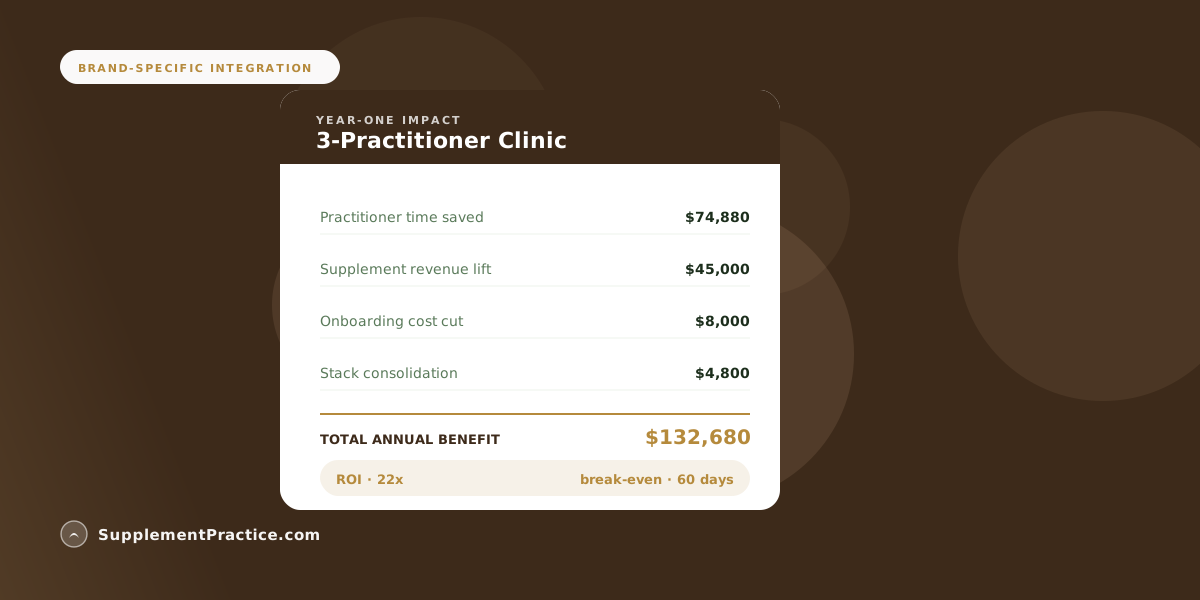
3-practitioner clinic, 5-year Fullscript user, migrating to integrated platform
A 3-practitioner FM clinic ran on Fullscript for 5 years alongside Practice Better for charting. The combination served them well during 2020-2024 growth from 280 to 680 active patients. By Q1 2025, operational drag was meaningful — practitioners spending Saturday catching up on protocol composition, reconciliation work between Practice Better and Fullscript consuming front-desk time, no Master Protocol library to support the new practitioner they'd hired in late 2024.
Evaluation: tested integrated platforms with AI Co-Pilot, native catalog, inventory binding. Operational projections suggested 25-35% time savings per practitioner. Dropship margin economics roughly equivalent to Fullscript with some upside on physical-dispense margin (which Fullscript didn't address).
Migrated over 4 weeks. Productivity dip during weeks 1-2 as the team learned the new workflow. By week 5, operating at projected steady state — Saturdays no longer needed for protocol composition, reconciliation backlog eliminated, the new practitioner reaching clinical fluency faster than the prior hire. Year-1 ROI projection: ~22x platform cost.
The dropship margin question
The most common concern during Fullscript migration evaluation is the practice's existing dropship margin revenue. Practitioners worry that switching platforms means losing this income stream.
In practice, integrated platforms support dropship economics comparable to or better than Fullscript's. The practice doesn't lose the dropship-margin revenue — and it typically gains additional revenue from improved adherence (more reorders) and from physical-dispense margin (which dispense-only platforms don't address). Verify the platform's dropship economics during evaluation, but don't let the concern itself block the conversation.
The migration timeline
3-6 weeks for a clean migration. Patient data export from the chart system, supplement order history from Fullscript, scheduling and billing data from any separate tools. Training the team on the new integrated workflow. Most platforms offer dedicated migration support.
The operational disruption during migration is usually less than feared in advance. Weeks 1-2 see a productivity dip (~10-20% reduction); weeks 3-4 return to baseline; weeks 5+ exceed baseline meaningfully.
Common mistakes
Anti-patterns in evaluating the migration
- Comparing Fullscript directly to the integrated platform's dispense module. The dispense module isn't the whole comparison; the integrated workflow is.
- Letting dropship-margin concerns block evaluation. Most integrated platforms match or exceed Fullscript's economics.
- Underestimating the AI composition + Master Protocol leverage. The compounding time savings and onboarding benefits are the real prize.
- Not running a structured pilot. A 4-week pilot with 1-2 practitioners produces the data needed for a confident migration decision.
- Migrating without canceling Fullscript. Stack consolidation savings require actually decommissioning the replaced tool.
Frequently asked questions
What is Fullscript and what does it do well?
Practitioner-grade supplement dispensary platform with clean dispensing workflow, broad brand catalog, reliable dropship. Solid as a dispense tool.
Why are practitioners leaving it?
Five reasons: dispense-focus without chart integration, no AI protocol composition, disconnected inventory, no practice-level Master Protocol library, weaker retention dynamics than integrated chart+dispense.
Does Fullscript integrate with chart systems?
Yes, with Practice Better, Healthie, others. Integrations help but don't deliver the full integrated experience — data flows are limited; AI composition isn't part of the integration.
What does "integrated all-in-one" mean?
Single platform handling chart, scheduling, intake, AI protocol composition, supplement catalog with brand filtering, inventory binding, invoicing, patient communication. No tool-switching.
What about existing Fullscript margin revenue?
Migration platforms typically support comparable or better dropship economics; practice often gains additional revenue from physical-dispense margin and improved adherence.
What's the migration timeline?
3-6 weeks. Operational disruption usually less than feared. Weeks 1-2 dip, weeks 3-4 baseline, weeks 5+ above baseline.
What is the best Fullscript alternative for practitioners?
The strongest Fullscript alternatives are integrated all-in-one platforms that put the dispensary inside the patient record alongside the chart, scheduling, and billing — rather than beside them as a separate storefront. Fullscript is excellent as a dispensary, but practitioners increasingly move to platforms where the protocol, the chart, and the reorder live in one place, which removes the reconciliation work of running a separate system. Evaluate alternatives on whether the dispensary is part of the record, whether it carries the brands you prescribe, and whether it protects your margins.
Is Fullscript free for practitioners, and what is the trade-off?
Fullscript is free to use because it earns its margin on the supplement sales that flow through it — you take a dispensing markup and Fullscript takes its cut. The trade-off is not a monthly fee; it is that the dispensary lives outside your clinical record, so protocols, charts, and reorders are maintained in separate systems that drift apart over time. An integrated platform typically charges a subscription but keeps everything in one record, which is what most switchers are actually paying for.
Can I move my patients and protocols off Fullscript without losing recurring revenue?
Yes. Recreate your active protocols in the new platform, invite patients to the new dispensary, and set their maintenance protocols to auto-refill so recurring revenue transfers with them. Most practices run both in parallel for a short window and move patients at their next refill or visit rather than all at once, so no reorder revenue is interrupted. Our guide on switching platforms without losing patient data walks the full migration.
Where to go next
Three companion pieces: ROI math on platform migration, the broader legacy-software case, and virtual dispensary economics. Supplement Practice is the integrated FM-native platform addressing all five gaps directly.