The ROI math on switching to an AI-powered practice management platform isn't speculative — it decomposes into four concrete levers (practitioner time saved, supplement revenue lift, onboarding cost reduction, stack consolidation) that each produce measurable dollar value. The realistic year-one numbers vary by clinic size and migration completeness, but the pattern is consistent across the practices we've worked with. This piece walks through the math for solo, 2-3 practitioner, and 5+ practitioner clinics, plus the risks that can erode the projected ROI.
Year-One ROI by Clinic Size
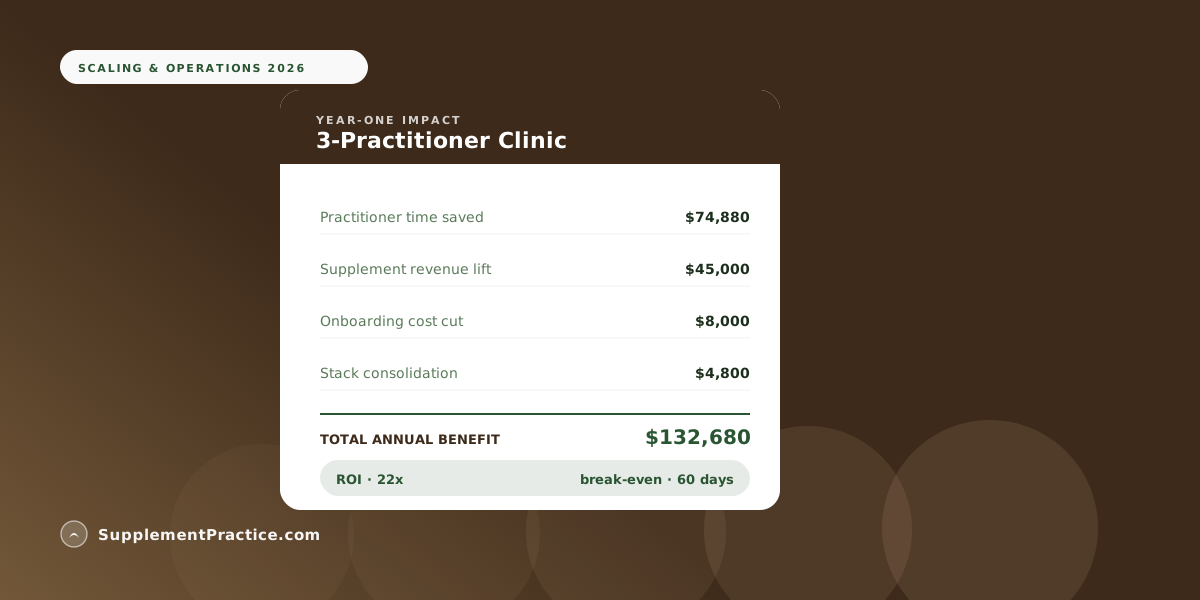
| Lever | Solo | 2-3 practitioner | 5+ practitioner |
|---|---|---|---|
| Practitioner time saved | $25–45K | $60–90K | $130–200K |
| Supplement revenue lift (+20–35%) | $12–22K | $35–55K | $80–140K |
| Onboarding cost reduction | — | $5–10K | $15–30K |
| Stack consolidation | $2–4K | $4–7K | $8–15K |
| Total year-1 benefit | $39–71K | $104–162K | $233–385K |
| Annual platform cost (approx) | $2K | $5–6K | $12–18K |
| Year-1 ROI multiple | ~20–35x | ~18–28x | ~15–25x |
The four ROI levers, decomposed
The ROI math depends on four concrete levers, each with measurable inputs.
Practitioner time saved. Per-protocol time drops from ~95 minutes (manual workflow with tab-switching and post-visit composition) to ~12-15 minutes (AI Co-Pilot with native catalog and override review). Across a practitioner running 25 protocols/week, that's 6-10 hours of weekly time recovered. At a typical functional medicine practitioner's effective hourly cost — $80-150/hour considering revenue per visit and overhead allocation — the annual value runs $25-45K per practitioner.
The time-savings lever scales linearly with practitioner count, which is why multi-practitioner clinics see the biggest absolute numbers. A 3-DC chiropractic clinic with all 3 DCs running supplement protocols realizes ~$75-130K of recovered time value annually.
Supplement revenue lift. Three mechanisms drive 20-35% revenue improvement on the supplement portion of practice income. Higher refill compliance because protocols are composed in-visit with the patient present (20-point adherence lift versus emailed protocols). Reduced stockout abandonment because real-time inventory binding means patients walk out with full protocols. More cross-brand stacking because the AI makes assembly across multiple brands operationally easy when the practitioner is on the fence about a 6th SKU.
For a practice with $20-30K/month in supplement revenue, a 25% lift is $5-7.5K/month — $60-90K annually. This lever is the biggest revenue mover in most practices.
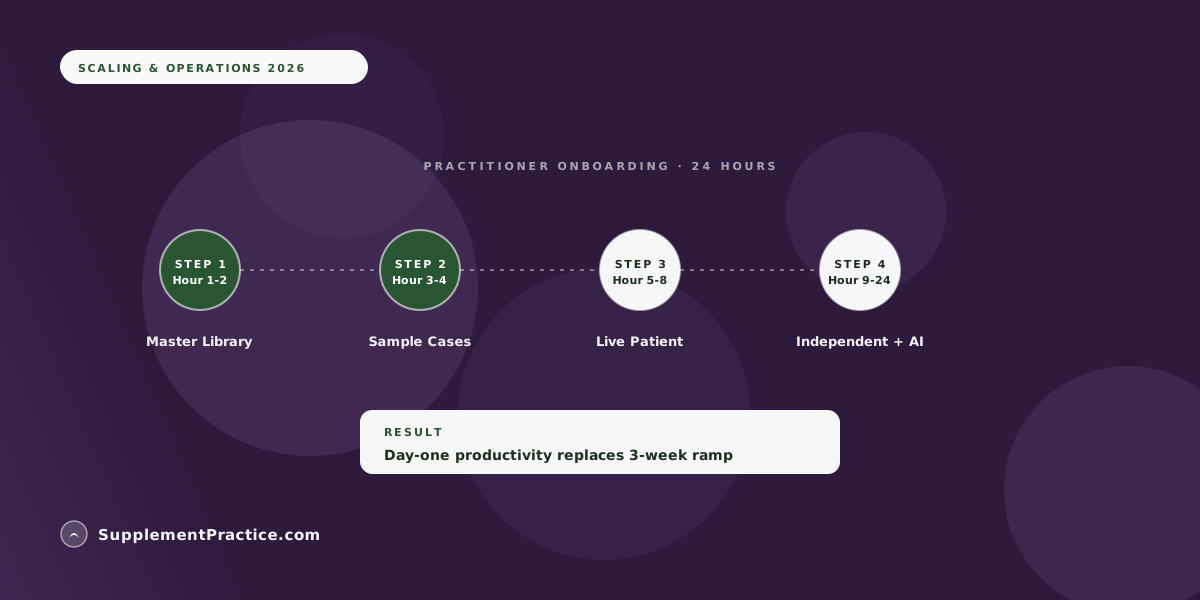
Onboarding cost reduction. New-practitioner onboarding in functional medicine practices typically runs 90-120 days from hire to clinical fluency. Codified Master Protocol templates and AI-supported workflow compress that to 30-45 days. The cost saved is the difference in below-target productivity during onboarding, plus the supervising-practitioner time spent training, plus the patient-experience hit during the learning curve. For a clinic that hires 1-2 practitioners per year, this runs $5-30K depending on practice size.
Stack consolidation. Most practices entering the migration are running 3-8 separate tools — scheduling, EHR, supplement catalog/dispensary, billing, patient communication, telehealth, intake forms. Consolidating onto a unified platform replaces several of these, with combined subscription savings of $3-15K annually depending on which tools are being consolidated.
Why most practices hit breakeven in 45-60 days
The platform cost is sunk monthly or annually; the benefits start accruing in week 3-4 as the workflow reaches steady state. For a 2-3 practitioner clinic at $5K annual platform cost, breakeven requires roughly $415/month of recovered value. Time savings alone — 18-30 weekly hours saved across practitioners at typical effective hourly cost — clears that threshold in the first month of steady-state operation. Revenue lift adds on top. Stack consolidation savings (when the old tools are actually canceled) are pure margin.
The 45-60 day breakeven assumes the practice executes the migration completely. Practices that adopt partially — bolt-on AI without integrated catalog, or AI without inventory binding — break even later because the savings depend on the integrated workflow.
3-practitioner integrative clinic, full year-1 ROI tracked
A 3-practitioner integrative medicine clinic ran the migration in Q1 2025 with disciplined before/after measurement. Pre-migration baseline: per-protocol time averaged 87 minutes across the three practitioners; supplement revenue averaged $24K/month; the practice was running Acuity Scheduling, a generic EHR, Fullscript for dispensing, Stripe for billing, and a separate intake forms tool.
Year-1 results (12 months post-migration):
- Per-protocol time at steady state: 14 minutes. Weekly time recovered: ~28 hours across 3 practitioners. Annual time-value: $94K (at $65/hr blended effective cost).
- Supplement revenue: $32K/month average (+33% lift). Annual revenue lift: $96K.
- Stack consolidation: replaced Acuity, Fullscript, and the intake forms tool. Annual subscription savings: $5,400.
- Hired 1 new practitioner mid-year; onboarding from hire to clinical fluency was 38 days versus the previous typical 105 days. Estimated onboarding cost reduction: $11K.
Total year-1 benefit: ~$206K against an annual platform cost of $5,760. Year-1 ROI multiple: ~36x. The practice reinvested most of the recovered time into adding a 4th practitioner (now onboarding); the recovered revenue funded the expansion.
Where ROI compounds in year 2
Year 1 ROI is driven by time savings, revenue lift, and onboarding/consolidation. Year 2 adds compounding effects that don't show up in the year-1 math.
Lower practitioner turnover. Burnout-driven practitioner turnover in functional medicine runs around 15-25% annually. The reduced after-hours documentation and protocol-composition load drops this materially — anecdotally to 5-10% in the practices that have completed the migration. Each retained practitioner saves $30-60K in recruiting/onboarding cost the following year.
Higher patient LTV. Improved adherence in year 1 leads to longer patient relationships in year 2. A 60-day retention lift translates to roughly 4-8 months of additional patient lifetime, which on a $1,500-2,500 annual per-patient supplement spend is meaningful.
Referral pipeline compounding. Retained, satisfied patients refer. The compound effect across 18-24 months is hard to attribute cleanly but consistently shows up as patient-acquisition cost reduction in practices that have completed the migration.
ROI risks and how to plan for them
Three real risks can erode the projected ROI.
Incomplete migration. Adopting AI without integrated catalog produces partial savings; adopting catalog integration without inventory binding produces partial savings. The biggest ROI failures come from practices that try to bolt the AI Co-Pilot onto a legacy EHR with separate dispensary tools. Full migration is the precondition for full ROI.
Practitioner resistance to the override rhythm. Practitioners who can't shift from author to reviewer leave most of the time savings on the table. The fix is shadow-mode training during weeks 1-2. Cost: 2-4 weeks of slower than baseline performance. Risk if skipped: the practitioner reverts to manual composition habits, and the ROI math collapses.
Inventory data drift. The carried-brands list and on-hand stock counts need ongoing maintenance. Practices that treat these as one-time setup tasks see the AI's recommendation quality degrade within 6 months as the configuration drifts from reality. Plan for a 30-minute weekly inventory data review.
Common mistakes
Anti-patterns that erode the ROI
- Not canceling the old tools. Stack consolidation savings require actually canceling the tools you're replacing. Practices that keep paying for both Acuity and the new platform "just in case" never realize the consolidation lever.
- Not measuring before/after. Without baseline measurement, the ROI math is asserted rather than demonstrated. Spend a week tracking per-protocol time and supplement revenue before migration.
- Underbudgeting onboarding time. The 4-8 hours of initial setup needs dedicated time, not stolen lunch-hour time. Block it.
- Ignoring practitioner satisfaction as a metric. Practitioner satisfaction with the workflow drives the year-2 turnover-reduction lever. Survey quarterly.
- Optimizing for one lever only. Practices that focus only on time savings (ignoring revenue lift) or only on revenue (ignoring time) leave half the ROI unrealized.
Frequently asked questions
What's the typical year-one ROI on this transition?
15-35x platform cost depending on clinic size and migration completeness. Time savings is the biggest lever, supplement revenue lift second, then stack consolidation and onboarding cost reduction.
How fast does the transition pay back?
45-60 days for practices that execute the full migration. Practices with partial adoption hit breakeven later or not at all.
What does "supplement revenue lift" actually come from?
Higher 90-day refill compliance (in-visit protocols adhere 20+ points better), reduced stockout-driven abandonment (real-time inventory binding), and more cross-brand stacking the practitioner didn't have time to compose manually.
What's the ROI for a solo practitioner specifically?
$25-45K time savings, $12-22K revenue lift, $2-4K stack consolidation against a ~$2K platform cost — 20-35x ROI. The non-financial benefit (recovered evenings, eliminated weekend catch-up) is often more decisive for solo practitioners.
How is ROI different at 5+ practitioner scale?
Time-savings lever scales linearly per practitioner. Codified Master Protocols compress new-practitioner onboarding from 90-120 to 30-45 days — meaningful for clinics in growth mode. Stack consolidation scales because larger clinics replace more tools.
What ROI risks should I plan for?
Incomplete migration (partial adoption produces partial savings), practitioner resistance to the override rhythm (fixable with shadow-mode training), and inventory data drift (carried-brands list needs ongoing maintenance).
Where to go next
Three companion pieces: the per-protocol time-savings breakdown, the five-step migration plan, and the broader business model around a whole-food-anchored dispensary. Supplement Practice reports per-protocol time and supplement revenue per practitioner inside the dashboard so the ROI math is measured, not asserted.