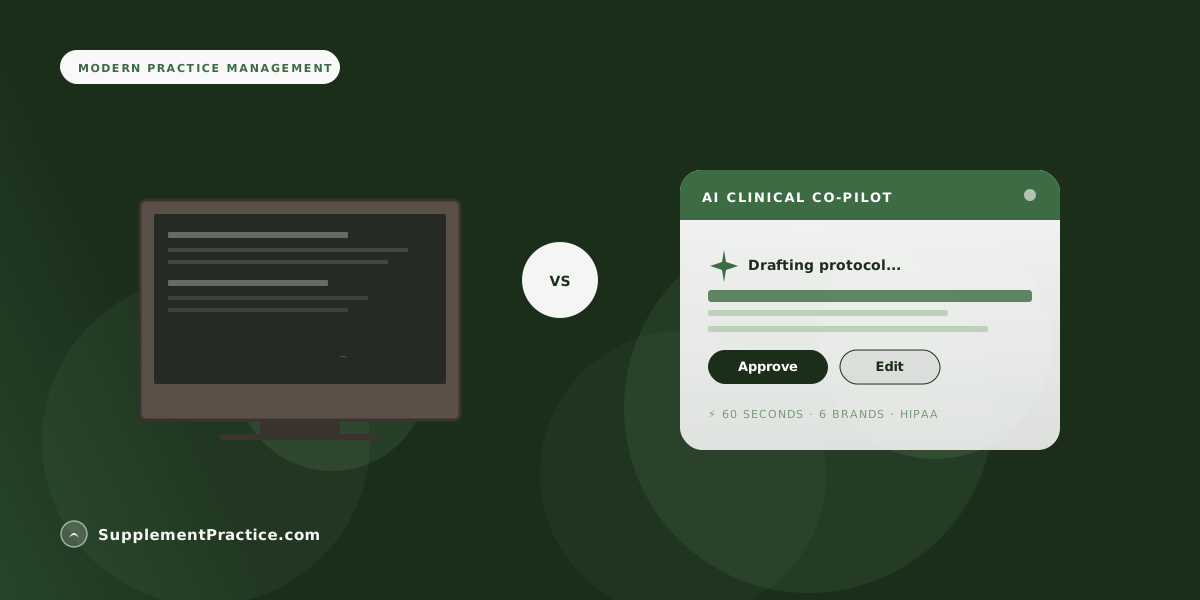
The migration from manual supplement research to an AI Clinical Co-Pilot workflow is more of an identity shift than a software install. The practitioner stops being the author of every protocol and becomes the reviewer-and-overrider; the AI handles the catalog-and-composition layer that was eating most of the practitioner's after-hours time. This piece walks through the five concrete migration steps, the 30-day ramp, the cultural change inside the practice, and the failure modes that prevent the savings from materializing.
Five-Step Migration to AI Co-Pilot Protocol Workflow
- 1. Digitize patient intake into a structured pre-visit survey
- 2. Integrate carried brands with the "we carry" filter set
- 3. Codify 5–10 most-used protocols as Master Protocol templates
- 4. Train the practitioner override rhythm (review, don't author)
- 5. Measure per-protocol time + adherence before/after
- 30-day ramp to steady-state; 2-3 months to full operational change
What "research hours" actually are in a functional medicine practice
The phrase suggests scholarly time spent reading PubMed, but the bulk of the hours is operational rather than intellectual. A typical 30-90 minute post-visit "research" session for a functional medicine protocol breaks down as: 10-15 minutes cross-checking interactions across the patient's medications and proposed supplements; 15-25 minutes looking up brand SKUs across 3-5 catalog websites; 10-15 minutes composing the AM/PM dosing schedule and computing bottle-supply math; 5-10 minutes writing the chart note that documents the protocol decision-making. The "research" is mostly catalog navigation, composition mechanics, and documentation — none of which requires the practitioner's clinical judgment in a way the AI can't reproduce.
This is the work the AI Clinical Co-Pilot eliminates. What stays with the practitioner: the clinical reasoning about which root-cause pattern to address first, the patient-specific dose adjustments, the override decisions when the AI's draft doesn't match the practitioner's clinical sense, and the patient conversation.
Step 1: Digitize the patient intake
The AI Co-Pilot's draft quality is bounded by the intake quality. A paper intake completed during the visit, with the practitioner reading the patient's handwriting, is not the input the AI workflow needs. The pre-visit digital intake — completed by the patient on their own time before the appointment — produces dramatically better drafts because the AI has structured data to ground on.
The intake should cover, at minimum: chief complaints with severity ratings, full active medication list, supplement history (current and past 12 months), recent lab uploads (PDF or photo), allergies and sensitivities, dietary patterns, sleep/stress/exercise baselines. For SP-anchored practices, the Symptom Survey runs as part of the intake. For other practices, a structured functional-medicine intake works similarly.
Completion rate matters operationally. Digital intakes complete at 80-90% rates when designed well; paper intakes complete at 50-65%. The 30-40 point gap is the difference between the AI workflow running smoothly and the practitioner constantly running with incomplete data.
Step 2: Integrate the carried brands
The "we carry" filter is the single most important configuration step in the migration, and the one most practices spend the least time on. Mark each product in the catalog as carried-or-not-carried; the AI then only recommends products the practice can actually dispense. This takes 1-3 hours of front-desk time for a practice carrying 60-100 SKUs across 2-3 brands.
The filter setting needs ongoing maintenance — when the practice drops a brand or adds new SKUs, the filter has to reflect the change immediately or the AI starts recommending products the patient can't get. Practices that treat the carried-brands list as a one-time setup task lose the benefit within 3-6 months as the configuration drifts from reality.
Step 3: Codify the 5-10 most-used protocols
Across most functional medicine practices, 5-10 protocol patterns account for 60-70% of total prescribing. Adrenal/HPA support, post-adjustment recovery, foundational wellness, methylation, gut restoration, cardiovascular foundation, perimenopausal hormone support, and a handful of practice-specific patterns. Codifying these as Master Protocol templates means the AI starts drafts from a known clinically-validated baseline, with the practitioner adjusting for patient specifics.
The codification work is a 4-6 hour exercise the practitioner does once: write the SKUs, doses, sequencing, and rationale for each template; mark which intake patterns route to which template. Once codified, every matching patient gets a starting protocol that already reflects the practice's clinical philosophy, and the override work becomes patient-specific tuning rather than from-scratch composition.
Step 4: Train the override rhythm
The biggest cultural shift in the migration is the practitioner's relationship with the protocol. Manual workflow: the practitioner is the author. AI workflow: the practitioner is the reviewer-and-overrider. Some practitioners take to this naturally; others resist because authoring feels like clinical authority and reviewing feels like rubber-stamping. The resistance is real and worth taking seriously.
The training pattern that works: spend a week using the Co-Pilot in shadow mode. Let the AI draft alongside the practitioner's manual composition; compare the two; note where the AI was right, where the practitioner overrode, and why. By the end of the week, the practitioner has calibrated trust — they know which draft elements to scan past versus which to scrutinize.
Override rate at steady state runs 40-60% in well-functioning practices. The practitioner is not rubber-stamping; they're catching the patient-specific tuning the AI can't make. But the friction has moved from composition to review, which is a much cheaper cognitive task.
Step 5: Measure before and after
Practices that don't measure the transition can't tell whether it's working. Track three things across the 90 days before and after migration. Per-protocol time (minutes from intake review to chart-note approval). Patient 30-day adherence (refill rate at first follow-up). Practitioner-reported satisfaction (qualitative, but consistent over time). The data is its own incentive: when the practitioner sees that the time savings are real and the adherence numbers held or improved, the cultural shift completes itself.
Solo naturopath migration over 6 weeks, with the 4 specific moments where the workflow shifted
A solo naturopath ran the full migration over 6 weeks. The data points worth recording:
Week 1. Per-protocol time tracked at 78 minutes (pre-migration baseline). 0 protocols composed via Co-Pilot. Practitioner spent the week configuring brands and codifying templates.
Week 2. 8 protocols composed via Co-Pilot in shadow mode (AI drafted, practitioner manually composed alongside, compared). Per-protocol time: 102 minutes (slower than baseline — the comparison work added overhead). Critical moment: practitioner noticed the AI's drafts were 85% identical to her manual composition; the 15% difference was patient-specific tuning she'd been doing instinctively.
Week 3. 14 protocols composed via Co-Pilot in primary mode (AI drafts, practitioner reviews and overrides). Per-protocol time: 38 minutes. Override rate: 55%. Critical moment: the practitioner trusted the foundational-stack portion of the draft and stopped re-checking SKU details, focusing review attention on the targeted-intervention layer.
Week 4-5. 32 protocols. Per-protocol time: 18 minutes. Override rate: 47%. Critical moment: the practitioner moved Friday afternoons from "protocol catch-up" to "patient face time + 1 extra appointment slot."
Week 6. Per-protocol time: 14 minutes. Override rate: 42%. The practitioner described the shift as "I'm doing the clinical thinking I was always supposed to be doing; the AI does the work that wasn't really clinical thinking, it just felt like it."
The failure modes that prevent the migration from working
Across the practices we've seen attempt this migration, four failure modes appear consistently.
Authoring instead of reviewing. Practitioners who can't break the from-scratch composition habit. The fix is the shadow-mode week — calibrate trust by seeing the AI draft alongside manual composition.
Skipping the carried-brands configuration. Without the filter, the AI recommends products the practice can't dispense, and the practitioner has to override every time. The fix is spending the 1-3 hours of configuration before activating the workflow at scale.
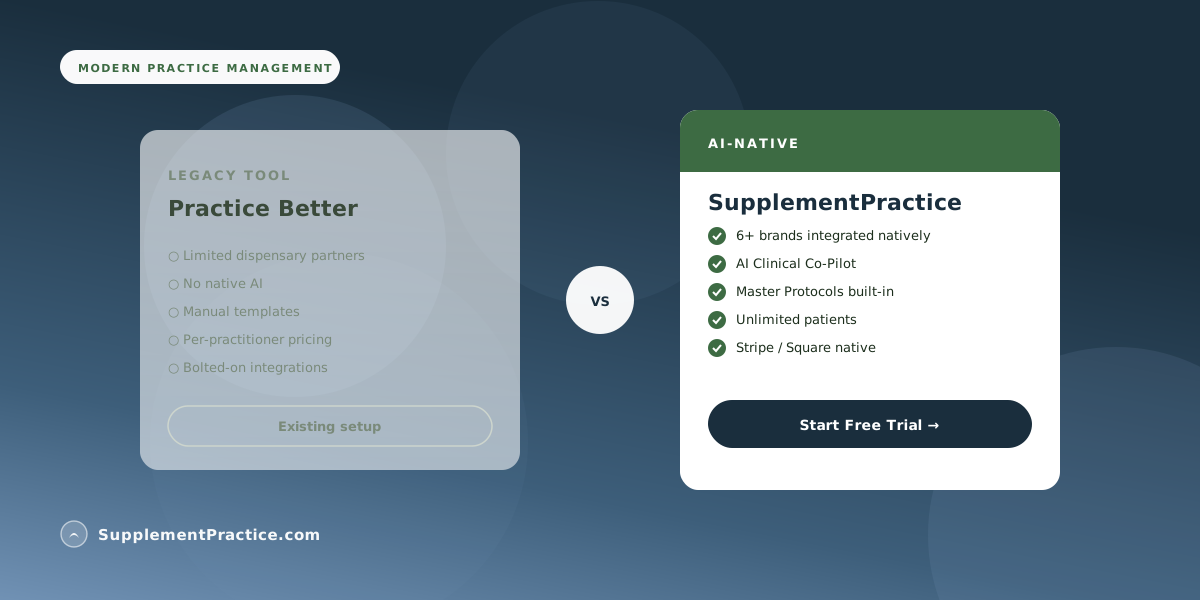
Bolt-on AI without integrated catalog. Practices that try to use AI as an add-on to a legacy EHR with a separate brand catalog reintroduce the tab-switching friction. Partial savings; not the full transition.
No template codification. Skipping step 3 means every protocol composition starts from cold draft instead of from a clinically-validated template. The savings are real but smaller — maybe 50-60% reduction instead of 80-85%.
Common mistakes
Five anti-patterns we see during migration
- No before/after measurement. Practices that don't time-track the transition can't defend it to themselves or to anyone else. Track minutes; track adherence.
- Compressing the patient conversation. Time savings should flow into face time or out of after-hours work, not into shorter visits.
- Rubber-stamping AI drafts. If override rate is < 25%, the practitioner is probably trusting too much. The AI is good but not infallible; override rate should stay in 40-60% range.
- Not running shadow mode. The trust-calibration week is the difference between a smooth migration and a stuck practitioner.
- Static template library. Master Protocol templates need quarterly review as the practice's clinical patterns evolve.
Frequently asked questions
What does "replace manual supplement research" actually mean?
Moving from a workflow where the practitioner authors every protocol manually to a workflow where the AI Co-Pilot drafts from intake and the practitioner reviews-and-overrides. Clinical thinking stays with the practitioner; operational composition moves to the AI.
What are the five steps of the migration?
1) Digitize patient intake. 2) Integrate carried brands with the "we carry" filter. 3) Codify the 5-10 most-used protocols as templates. 4) Train the practitioner override rhythm. 5) Measure per-protocol time and adherence before/after.
How long does the migration take?
Initial setup is 4-8 hours of configuration. Practitioner ramp to steady-state override fluency is 3-4 weeks. Full operational change (visit-volume adjustments, schedule restructuring) by month 2-3.
What's the cultural change inside the practice?
The practitioner stops being the bottleneck for protocol composition and shifts identity from "I write every protocol from scratch" to "I supervise and override." For most practitioners this relieves background cognitive load.
What's the biggest failure mode in the migration?
Practitioners who try to author protocols from scratch even when the AI has drafted a reasonable starting point. The fix is the shadow-mode week — calibrate trust by comparing AI drafts against manual composition.
Does the migration require changing EHR or charting systems?
Not strictly, but practices that get the most value migrate to a unified system where chart, catalog, AI Co-Pilot, inventory, and patient communication all live together. Bolt-on AI on a legacy EHR produces partial savings.
Where to go next
Three companion pieces: the per-protocol time breakdown that shows where the 80% savings comes from, the dollar ROI on the platform transition, and how Master Protocol codification carries through to new-practitioner onboarding. Supplement Practice includes a migration onboarding workflow that walks the practice through the five steps with measurement baked in.