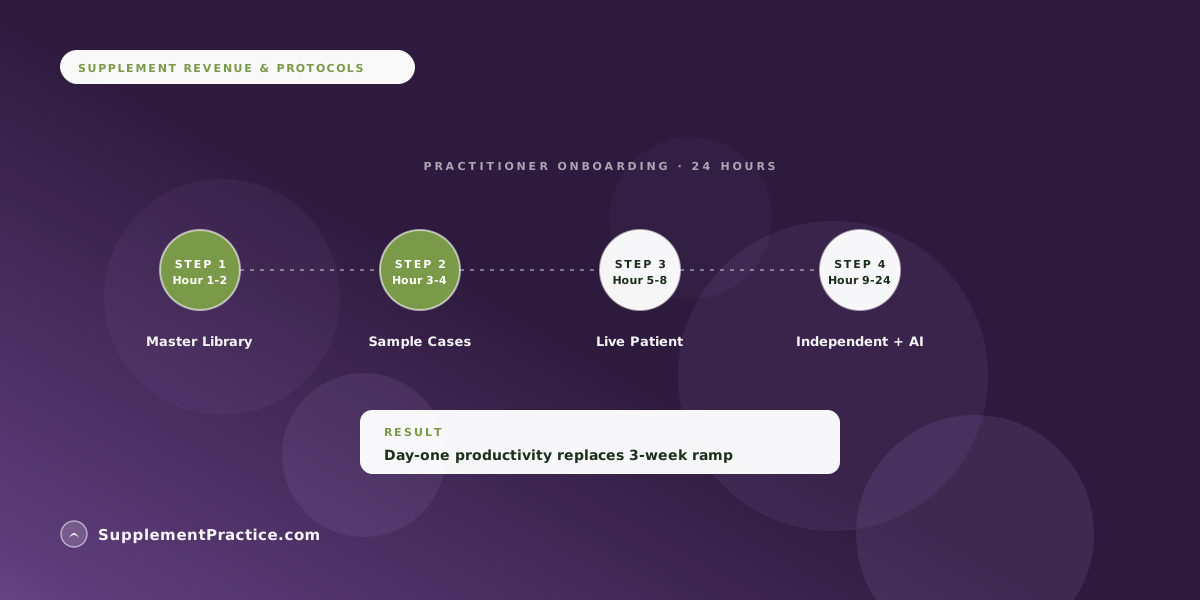
Master Protocols are the single highest-leverage operational asset for a growing wellness practice. Done well, they compress new-practitioner onboarding from 90-120 days to 30-45 days, reduce per-protocol composition time by 60-75%, and externalize the senior practitioner's clinical reasoning into reusable infrastructure. Done badly or skipped entirely, they leave the practice dependent on the founder's tribal knowledge, with all the growth-ceiling and key-person-risk problems that creates. This piece walks through the practical build process — identifying which templates to build, encoding clinical reasoning, supervising new-practitioner use, and evolving the library over time.
Building the Master Protocol Library
- Run 90-day prescribing audit to identify the 8-12 most-used phenotypes
- 4-8 hours per template, senior practitioner authoring
- Each template: phenotype trigger, products + doses, rationale, sequencing, outcome markers
- Weekly supervision review for new practitioners' first 60 days
- Quarterly template review: revise high-override templates, incorporate findings
- Result: 30-45 day onboarding, predictable cross-practitioner quality
The 90-day audit that identifies which templates to build
Don't start by guessing which templates the practice needs. Run a 90-day audit of recently prescribed protocols and let the data tell you. The 8-12 most-prescribed patient phenotypes typically cover 60-75% of total prescribing volume. That's where the template library should start.
Common starting set for FM practices: adrenal/HPA support, foundational wellness baseline, post-adjustment recovery (for chiropractic-adjacent practices), methylation support, gut barrier restoration, cardiovascular foundation, perimenopausal hormone support, autoimmune anti-inflammatory baseline, thyroid support, blood-sugar regulation. Niche templates for the practice's specific clinical focus areas — pediatric foundational, athletic-performance, fertility support, etc.
The audit also reveals which patient patterns are not well-served by the current prescribing — areas where the senior practitioner is consistently composing similar protocols ad-hoc that would benefit from being templated. These are the highest-leverage templates to build.
The five sections every Master Protocol template needs
1. Patient phenotype trigger. What intake patterns route to this template? Specific symptom combinations, lab markers, medication patterns, demographic factors. The AI uses these to identify when a patient matches the template; the practitioner uses them to understand why the template was selected.
2. Product list with layers. Foundational layer (Catalyn + Cataplex F + Tuna Omega-3 or equivalent), targeted layer (the condition-specific products), optional layer (products to add if specific patient factors are present). Each product carries the clinically-validated default dose, with the range the practitioner may use.
3. Dosing rationale. Why each product, why each dose, where the override is most likely. This is where the senior practitioner's clinical reasoning gets externalized. Example: "Drenamin 2 AM — protomorphogen adrenal substrate; AM only because of subtle stimulating activity; 2 tablets for typical adult; reduce to 1 for elderly or polypharmacy patient."
4. Sequencing and duration. Acute vs maintenance phases. Day 0-30: initial loading. Day 30-60: transition. Day 60+: maintenance or step-down. Clear duration markers so the practitioner knows when to reassess.
5. Outcome markers. What to look for at 30, 60, 90 days to validate the protocol is working. Symptom markers, lab markers, patient-reported outcome scales. This converts protocols from "we'll see how it goes" to measurable interventions.
The build process — what 4-8 hours per template actually looks like
Hour 1: Senior practitioner reviews 5-10 of their recent protocols for the target phenotype. Identifies the patterns — which products appear in most/all, which doses, which sequencing, which overrides they consistently apply.
Hours 2-3: Drafting the template structure. Phenotype trigger, product list with layers, default doses. The senior practitioner writes the rationale in their own voice as they go — capturing the verbal reasoning that usually stays implicit.
Hours 4-5: Outcome markers and supervision notes. What does success look like at 30, 60, 90 days? What patient-specific factors should trigger override? Where is a junior practitioner most likely to need senior input?
Hours 6-8: Review with another senior practitioner if available, refinement, encoding into the practice management system's template structure, testing against 3-5 retrospective patient cases.
Time investment for 10 templates: 40-80 hours of senior-practitioner time, typically spread over 2-4 weeks alongside normal clinical work. This is the investment that compresses years of new-practitioner onboarding work.
Solo practitioner → 4-practitioner clinic, template library investment pays back at hire #2
A founder-led FM practice grew from solo to 4 practitioners over 22 months. The founder invested 60 hours in Q2 of year 1 building 11 Master Protocols covering 72% of the practice's prescribing volume. This was time taken from clinical work; the founder reduced patient volume by ~15% that quarter to make room.
Payback analysis: Hire #2 reached clinical fluency at week 5 vs. the projected 14 weeks. The 9-week onboarding compression saved approximately $34,000 of below-target productivity. The 60 hours of template investment paid back at hire #2 alone.
Hire #3 (added at month 16): clinical fluency at week 4. Hire #4 (month 19): clinical fluency at week 4. Cumulative onboarding-time savings across hires 2-4: roughly $95,000 of practice value.
Secondary effects: founder's vacation time tripled (the templates meant the practice didn't depend on her physical presence). Patient quarterly satisfaction scores improved 6 points across the panel. Practitioner-side burnout indicators (self-reported) dropped meaningfully — practitioners felt supported by the templates rather than thrown into deep clinical waters with insufficient training.
The supervision rhythm during new-practitioner onboarding
Templates compress onboarding but don't replace supervision. The senior practitioner should review the new practitioner's protocols weekly for the first 60 days. The review focuses on overrides — which AI-drafted templates did the new practitioner modify, why, and did the modification reflect appropriate clinical judgment.
Patterns to watch for: under-override (new practitioner is rubber-stamping templates without applying clinical judgment), over-override (new practitioner is unnecessarily customizing in ways that don't reflect senior practice patterns), or off-pattern overrides (the new practitioner is consistently changing something the senior practitioner wouldn't have changed).
After 60 days, transition to monthly review for 6 months, then quarterly review as part of normal practice quality assurance.
When the senior practitioner can't articulate their reasoning
The single most underestimated obstacle to template building is that experienced clinicians often can't fully articulate their pattern-recognition. They know what works but can't explain why in transferable terms. Tacit knowledge is hard to externalize.
Two techniques help. Protocol-by-protocol narration: the senior practitioner composes 10 protocols while narrating their reasoning aloud, recorded or with a note-taker. The verbal reasoning gets captured and structured into templates afterward. Override analysis: instead of asking the senior to introspect, review 30 days of their actual prescribing for a phenotype. The patterns reveal themselves through the data even when the practitioner can't articulate them.
Common mistakes
Anti-patterns in template library building
- Skipping the prescribing audit. Builds wrong templates.
- Building too many templates initially. 25 templates is unmaintainable; start with 8-12.
- Building without rationale documentation. Templates without "why" don't teach new practitioners; they just provide outputs.
- Static templates without quarterly review. Stale within 6-12 months.
- Treating template completion as the end state. Supervision rhythm is the mechanism that develops new-practitioner judgment; templates without supervision don't produce maturity.
Frequently asked questions
How do I identify which Master Protocols to build first?
Run a 90-day prescribing audit. The 8-12 most-prescribed phenotypes typically cover 60-75% of volume. Build templates for those.
What goes into a Master Protocol template?
Phenotype trigger, product list with layers and doses, dosing rationale, sequencing and duration, outcome markers.
How long does it take to build the library?
4-8 hours per template; 10 templates = 40-80 hours of senior-practitioner time over 2-4 weeks alongside normal clinical work.
What's the new-practitioner supervision rhythm?
Weekly for first 60 days, monthly for next 6 months, quarterly thereafter. Focus: override patterns and clinical judgment development.
How do Master Protocols evolve?
Quarterly review. Templates with >70% override rates get revised. New clinical findings, brand catalog changes incorporated. Living document.
What if the senior practitioner can't articulate reasoning?
Two techniques: narrated protocol composition (verbal reasoning captured during 10 protocols), or override analysis (review actual data for patterns when introspection fails).
Where to go next
Three companion pieces: the broader standardization framework, accelerated new-practitioner onboarding mechanics, and team consistency mechanisms. Supplement Practice includes a Master Protocol library editor + override-rate analytics + supervision review queue that operationalize the workflow described above.