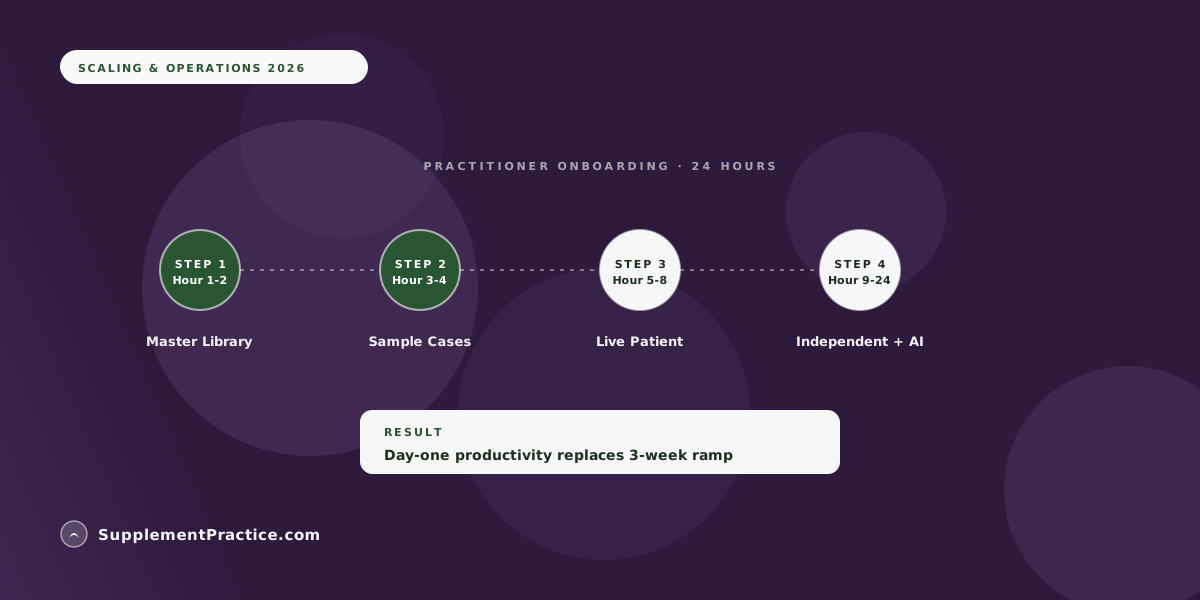
24-hour new-practitioner onboarding to clinical competence isn't a marketing claim — it's an operational reality for practices with the right infrastructure (Master Protocol library, AI Co-Pilot, structured intake, drug-interaction system). The 24 hours covers template walkthrough, AI shadow-mode practice, interaction system demonstration, and the 30-day supervision plan that develops clinical maturity past the initial competence threshold. The new practitioner doesn't reach full senior-practitioner judgment in 24 hours; they reach a starting point from which judgment develops via supervised practice rather than unsupervised trial and error.
24-Hour Onboarding Schedule
- Hour 1-3: Master Protocol library walkthrough with senior practitioner
- Hour 4-6: AI Co-Pilot tour — drafts, overrides, citations
- Hour 7-8: Drug-interaction system demonstration with test cases
- Day 2 hour 1-4: Shadow mode on 4-6 retrospective cases
- Day 2 hour 5-8: First live patient visits with senior on-call
- 30-day supervision rhythm: daily week 1-2, weekly week 3-4, monthly thereafter
The infrastructure prerequisites
24-hour onboarding only works when the practice has four pieces of infrastructure in place. Without them, the new practitioner falls back to traditional 90-120 day onboarding.
1. Codified Master Protocol library. 8-12 templates covering the practice's most common patient phenotypes. The library encodes the senior practitioner's clinical reasoning into reusable starting points.
2. AI Clinical Co-Pilot with catalog grounding. The new practitioner uses the AI to draft protocols against the practice's carried brands; this is how they prescribe at near-senior quality from day 2 without having yet developed senior pattern-recognition.
3. Structured digital intake system. Patients complete intake pre-visit; the AI analyzes it; the new practitioner sees structured output at the start of the visit. Eliminates the manual pattern-recognition workload the new practitioner hasn't yet developed.
4. Drug-interaction screening system. Working interaction screen against the patient's medication list. Catches what the new practitioner hasn't yet memorized.
Practices missing any of these can't deliver 24-hour onboarding. The infrastructure is the precondition.
The hour-by-hour schedule
Day 1, hours 1-3 — Master Protocol library walkthrough. Senior practitioner takes the new hire through every template in the library. For each: the patient phenotype that triggers it, the product list with layers, the dosing rationale, the override patterns the senior has accumulated. This is the new practitioner's accelerated absorption of years of accumulated clinical reasoning. Take notes; the templates become reference material the new hire returns to daily for months.
Day 1, hours 4-6 — AI Co-Pilot tour. How to use the Co-Pilot interface. What good drafts look like. How to read the rationale and citations. How to override (and how to document why). The Co-Pilot's role in the new practitioner's workflow vs. the senior's role.
Day 1, hours 7-8 — Drug-interaction system demonstration. Pick 5-6 deliberately-chosen test cases (warfarin + vitamin E, St. John's Wort + SSRI, calcium + levothyroxine, etc.). Run them through the interaction system. Verify the new practitioner can interpret the output and knows when to escalate to the senior.
Day 2, hours 1-4 — Shadow mode practice. Pull 4-6 retrospective patient cases from the recent past. The new practitioner composes protocols alongside the senior, comparing approaches. This is where the new practitioner's instincts get calibrated against the senior's. The single highest-leverage onboarding activity.
Day 2, hours 5-8 — First live patient visits. New practitioner sees 2-3 real patients with the senior practitioner physically nearby for real-time questions. AI Co-Pilot drafts the protocols; new practitioner reviews and modifies; senior is available to discuss any uncertainty. By the end of day 2, the new practitioner has prescribed competently for real patients.
The 30-day supervision plan
The 24 hours produces competent starting prescribing. Clinical maturity develops over the next 30 days through structured supervision.
Week 1-2. Senior practitioner reviews every protocol within 24 hours of approval. Off-pattern overrides get same-day conversation. Intense supervision but it catches every developing pattern before it consolidates into habit.
Week 3-4. Review shifts to weekly batch — senior practitioner reviews the new hire's prior-week overrides in a 30-minute session. The supervision intensity drops as the new practitioner's pattern-recognition stabilizes.
Day 30. Formal check-in. Override-rate metrics, outcome data if available, areas of clinical judgment that need additional development. The new practitioner moves to the standard team supervision rhythm (monthly review for 6 months, quarterly thereafter).
FM clinic, new practitioner onboarded in 2 days, full team-quality prescribing at day 14
A 4-practitioner FM clinic hired a new naturopath after their Master Protocol library and AI Co-Pilot infrastructure had been mature for 6 months. Onboarding ran the schedule above. By end of day 2: 3 live patient visits completed competently. By end of week 2: 28 patient visits completed; override patterns approaching team steady-state; senior practitioner's supervision review consistently surfacing minor refinements, not fundamental errors.
Day 30 check-in metrics: protocol composition time at team steady state (12-15 minutes per protocol). Override rate at 52% (within healthy 40-60% band). Patient adherence at first 30-day follow-ups: 78% (slightly below team's 81% average, but within normal variance for a new practitioner). Patient satisfaction scores: within team range.
The new practitioner reported feeling supported, not thrown in. The senior practitioner reported the supervision rhythm was manageable (~5 hours during week 1, declining to ~2 hours by week 4). The cost of the 24-hour onboarding investment was roughly 16 hours of senior practitioner time spread across 2 days plus ongoing supervision — vs. ~80 hours of supervision spread over a traditional 90-day onboarding for substantially worse clinical outcomes during the learning period.
What 24-hour onboarding doesn't cover
Worth being explicit about what the workflow does and doesn't produce. It does produce competent prescribing for routine cases starting day 2, supported by AI infrastructure and supervision. It does not produce: full clinical maturity (that's the 30-60 day arc with supervision), complex polypharmacy comfort (develops through case exposure over months), or nuanced patient-communication skill (develops through patient interaction, not template study).
Treat the 24 hours as a launch pad, not a finish line. The supervision over the subsequent 30 days is where most of the clinical development happens; the onboarding just gets the practitioner to a strong starting position.
Common mistakes
Anti-patterns in accelerated onboarding
- Attempting 24-hour onboarding without the infrastructure. Falls back to traditional timeline with the practitioner feeling unsupported.
- Skipping shadow mode. The calibration work happens here.
- Inadequate supervision in week 1-2. Patterns consolidate fast; catch them early.
- Treating onboarding as one-time event. The 30-day supervision plan is part of the onboarding, not after-onboarding.
- Not investing senior practitioner time honestly. 16 hours of senior time over 2 days + supervision rhythm. Plan for it.
Frequently asked questions
Is 24-hour onboarding realistic?
Yes, for the supplement-protocol portion of practice, when infrastructure is in place. Full clinical maturity still takes weeks; competent prescribing from day 2 is achievable.
What does the 24-hour schedule look like?
Day 1: 3hr templates + 3hr AI tour + 2hr interaction system. Day 2: 4hr shadow mode + 4hr live patient visits with senior on-call.
What infrastructure has to be in place?
Master Protocol library, AI Co-Pilot with catalog grounding, structured digital intake, drug-interaction system. Without these, falls back to 90-120 day traditional onboarding.
What's the 30-day supervision plan?
Week 1-2: 24-hour protocol review by senior. Week 3-4: weekly batch override review. Day 30: formal check-in; transition to standard team supervision rhythm.
What if the new practitioner is making mistakes I wouldn't?
Expected and the point of supervision. Surface off-pattern overrides in weekly review: "Why did you override this?" or "Why didn't you override this?" — develops judgment faster than any lecture.
How does this compare to traditional onboarding?
Traditional: 90-120 days to clinical fluency, variable quality during learning period, patient-experience cost. 24-hour: competent prescribing day 2, full maturity 30-45 days, supervision-mediated development without patient cost.
Where to go next
Three companion pieces: building the template library that makes this possible, the team consistency mechanisms, and the broader standardization framework. Supplement Practice includes an onboarding workflow that walks new practitioners through the template library, shadow-mode practice, and supervision review queue.