Personalization without fulfillment is theater. A patient regimen is only as real as the bottles you can hand the patient at the appointment — so the most important constraint on an AI Clinical Co-Pilot isn't its clinical intelligence, it's its access to your live inventory. This is the workflow that ties protocol drafting to physical stock, with the bottle-supply math, low-stock surfacing, and dropship fallback every practice needs.
Inventory-Aware Personalization Workflow
| Step | What happens |
|---|---|
| 1 | Patient submits intake; AI clusters root causes |
| 2 | Co-Pilot drafts protocol filtered to brands the practice carries |
| 3 | Each SKU checked against on-hand inventory in real time |
| 4 | Bottle-supply math computed for the protocol length |
| 5 | Low-stock items surface for substitution or dropship |
| 6 | Practitioner approves; inventory decrements, invoice generates |
| 7 | Patient gets printable AM/PM schedule + bottles in hand |
The protocol that loses the patient is the one you can't dispense at the appointment
Adherence research in pharmacotherapy is unambiguous about the first 14 days: if a patient doesn't initiate a regimen within that window, the odds they ever start it drop sharply. The same dynamic plays out, often more harshly, in supplement protocols — because supplement adherence is voluntary, the prescriber-pharmacist split doesn't exist to catch lapses, and the patient is paying out-of-pocket. The friction of "your supplements aren't in stock, go order them online when they arrive" is enough to lose 30–40% of patients before they take a single capsule.
This is why "personalized regimen" without "inventory-aware" is a marketing claim, not a clinical reality. The right framing isn't "can the AI find the optimal supplement?" It's "can the AI find the optimal supplement that the patient can take home from this appointment?" Those are different optimization problems and they often produce different answers.
What real-time inventory binding actually looks like
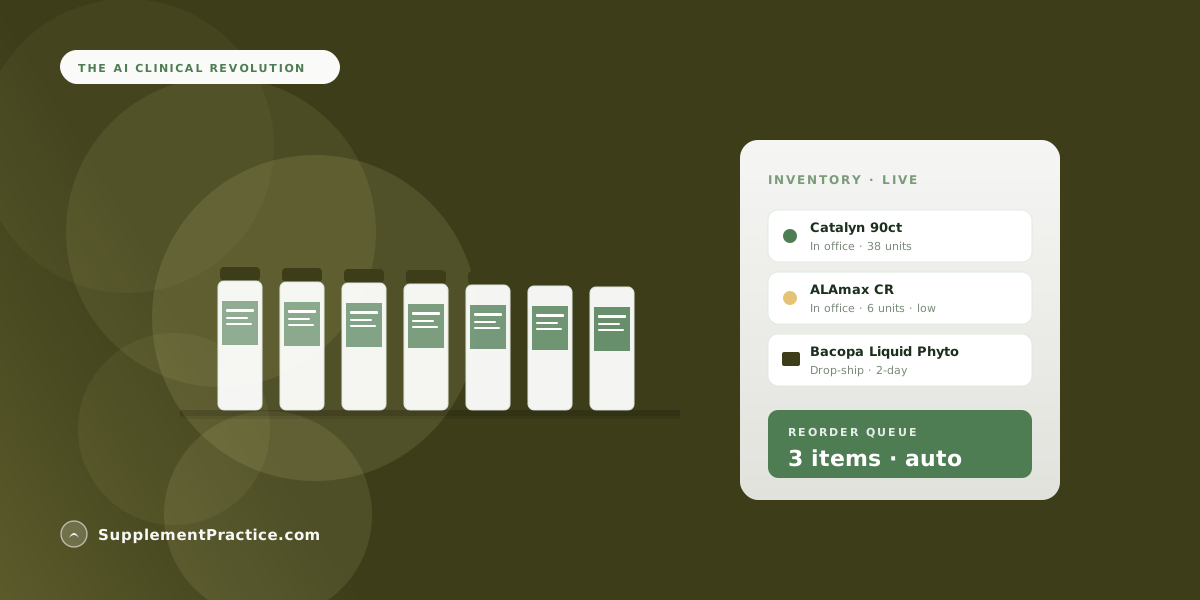
The technical mechanism is simple but it has to operate at draft time, not at checkout time. As the Co-Pilot composes the protocol, every candidate SKU is checked against the clinic's live on-hand count. The check is fast — milliseconds — and the result feeds back into the model's selection: if Standard Process Catalyn® is out of stock and the patient needs a foundational whole-food multivitamin, the Co-Pilot defaults to Gaia Herbs PRO Multi-Mineral Complex or Designs for Health Twice Daily Essential, whichever is in stock and clinically appropriate.
When nothing in the carried brands is available, the Co-Pilot surfaces a dropship option from the broader catalog with a clear "ships in 3–5 days" badge. The practitioner makes the call: substitute now, or accept the delay.
The bottle-supply math that most clinics get wrong by hand
Doing the math manually for a single product is trivial. Doing it across a 6-SKU stack for a 60-day protocol, with different bottle sizes and different daily totals, is where errors creep in. The formula is straightforward — days supply = pills per bottle ÷ daily dose; total bottles = ceiling(protocol length ÷ days supply) — but practitioners doing it on a notepad get it wrong somewhere between 4% and 8% of the time, based on what we see during onboarding audits. The errors usually go in one direction: under-dispensing, which surfaces as the patient running out mid-protocol and calling the clinic.
Here is the same example, fully expanded:
| Product | AM | PM | Daily total | Per bottle | Days supply | Bottles for 60d |
|---|---|---|---|---|---|---|
| Garlic Forte (SP) | 1 | 2 | 3 | 60 | 20d | 3 |
| Min-Chex® (SP) | 1 | — | 1 | 60 | 60d | 1 |
| AllergCo (SP) | 1 | — | 1 | 60 | 60d | 1 |
| Valerian Complex (SP) | 1 | — | 1 | 60 | 60d | 1 |
| Cataplex® B (SP) | 1 | 1 | 2 | 60 | 30d | 2 |
| Vasculin® (SP) | 1 | 1 | 2 | 60 | 30d | 2 |
Six products, 10 total bottles, 60-day protocol. A single ceiling-function error on the Garlic Forte row drops you to 2 bottles and the patient is out at day 40. The system computes this automatically because the cost of getting it wrong is the patient's trust in the regimen.
Multi-location chiropractic practice, 6 SKUs out of stock the morning of the appointment
A 4-DC clinic on a Friday morning realizes Catalyn, Cataplex B, and Min-Chex bottles ran low overnight from Thursday's protocols and weren't reordered. Three of the four practitioners have Friday morning HPA-and-cardiovascular new-patient visits scheduled — exactly the protocols those products anchor.
With inventory-aware drafting, each practitioner's Co-Pilot session for those visits automatically substitutes — Gaia Herbs PRO B-Complex for Cataplex B where clinically appropriate, Standard Process Drenamin for Min-Chex where the indication maps, and a dropship route flagged for the patients who genuinely need Catalyn. The clinic's front desk gets an automated low-stock alert with a one-click reorder. No appointment is rescheduled. No patient leaves empty-handed.
Before this workflow existed, the same Friday would have produced three rescheduled new-patient consults — a $1,800+ revenue loss and a meaningful trust hit with new patients in their first visit.
Hybrid physical + dropship: the economic logic
Practitioners ask whether they should carry physical stock at all. The economic answer is: carry the top 20–30 SKUs by velocity, dropship the rest. The math is dominated by three variables — bottle cost, carry rate (storage + opportunity cost of inventory dollars), and expiry risk.
The break-even sits around 5 bottles/month sold. Above that, physical carry produces meaningfully better margin (no dropship markup, same-day fulfillment, walk-in flexibility). Below it, the carry cost and the 5–8% expiry write-off on slow-moving supplements wipe out the margin advantage. The Co-Pilot should be configured to honor this split: recommend in-stock physical first, dropship the long tail without friction.
The other unmodeled variable is patient experience. A protocol that ships in 3 days from a centralized dropship warehouse arrives in better packaging and with more accurate labeling than most clinics produce manually. Practitioners sometimes resist dropship for the perceived loss of "the practice's brand" — but for the bottom-quartile-velocity SKUs, dropship is usually a quality upgrade.
Common mistakes when first connecting inventory to AI
Five anti-patterns we see during onboarding
- Treating inventory as a back-office concern. Front-desk staff often manage inventory in a spreadsheet the practitioners never see. If the Co-Pilot can't read from the same source of truth, the personalization breaks.
- Not setting a low-stock threshold. "Alert when 0" is too late. Set the threshold to 1–2 bottles for fast-movers and 1 bottle for everything else, with auto-reorder where the supplier supports it.
- Letting the Co-Pilot recommend SKUs the practice no longer carries. When you drop a brand, deactivate it in the carried-brands list. Otherwise the Co-Pilot will continue surfacing those SKUs and the practitioner has to remember to override.
- Manual reorder cycles. Standard Process, Xymogen, Designs for Health all support practitioner accounts with electronic reorder. Wire the reorder trigger to the system; eliminate the "I'll order Monday" failure mode.
- Ignoring expiry dates. Inventory counts that don't track expiry let you dispense bottles within 60 days of expiration on a 60-day protocol — embarrassing and avoidable. Set the system to flag any bottle within 90 days of expiration.
What the patient actually receives
Personalization is a word that often dies in implementation — "we personalized your regimen" but the patient walks out with a generic printout. The deliverable that survives the encounter is a printable AM/PM schedule with the patient's name, the practitioner's name, every product (brand + dose + timing), and a clear "next dose" cue. The same content lands in the patient's email. The schedule references the actual bottles the patient is taking home — same names, same brand, same dose — so there is zero cognitive translation between "what the practitioner said" and "what the patient is doing at 7 AM tomorrow."
This is the surface area where adherence is won or lost. A patient who can look at their phone and see "8 AM: 1 Catalyn, 1 Garlic Forte AM, 1 Min-Chex, 1 AllergCo, 1 Valerian, 1 Cataplex B AM, 1 Vasculin AM" doesn't have to remember a verbal instruction from a 40-minute appointment. They follow the schedule.
Frequently asked questions
Why does inventory matter when AI is drafting protocols?
Because protocols you can't fulfill don't get taken. The single most common reason a patient stops a regimen in the first 14 days is that one or two products were out of stock at checkout and the patient never got around to ordering them. An AI Co-Pilot that doesn't filter by on-hand inventory will confidently recommend SKUs the clinic can't dispense, and the practitioner finds out at the register.
What is bottle-supply math and why does it need to be automatic?
Bottle-supply math turns "1 AM + 2 PM = 3 capsules/day" for a 60-day protocol into "180 capsules needed, bottle size 60, so 3 bottles dispensed." Practitioners doing this by hand make arithmetic errors 4–8% of the time across a complex stack. Doing it inside the system also catches the over-dispense problem on shorter protocols.
How does the AI handle a product that goes out of stock between draft and dispense?
It surfaces the gap at approval, not at checkout. The protocol UI shows a low-stock indicator next to any product where on-hand count is less than the supply needed for the protocol length. The practitioner can substitute, reduce protocol length, or route the deficit to dropship without restarting the draft.
Should every clinic carry physical inventory, or use drop-ship?
Most clinics benefit from a hybrid. Carry physical stock for the 20–30 SKUs you turn over most (high-velocity, multi-patient products) and drop-ship the long tail. The economics favor physical carry on items where you'll move 5+ bottles a month; below that, carry cost and expiry risk usually wipe out the margin.
What happens to patient adherence when the protocol is fulfillable on day one?
In the practitioners we've worked with, 60-day protocol adherence rises by 18–35 percentage points when every SKU is available at the appointment versus when one or more require a follow-up order. Protocols that start same-day get measured at the 30-day follow-up; protocols that require a separate online order lose patients to inertia.
How does inventory integration interact with HIPAA?
Inventory records on their own aren't PHI — bottle counts of magnesium aren't patient-identifying. The linkage to a specific patient protocol is PHI and lives inside the chart's audit trail. Front-desk staff can operationally access inventory without full chart access; the patient-protocol linkage requires clinical access.
Where to go next
Three related pieces will fill in the surrounding workflow: how the Clinical Co-Pilot drafts the protocol in the first place, the physical-vs-virtual dispensary decision specifically for Standard Process clinics, and how dropship-only clinics avoid carrying any physical stock at all. Supplement Practice ties all three pieces together — the Co-Pilot, the inventory binding, and the dispense workflow — in a single chart.