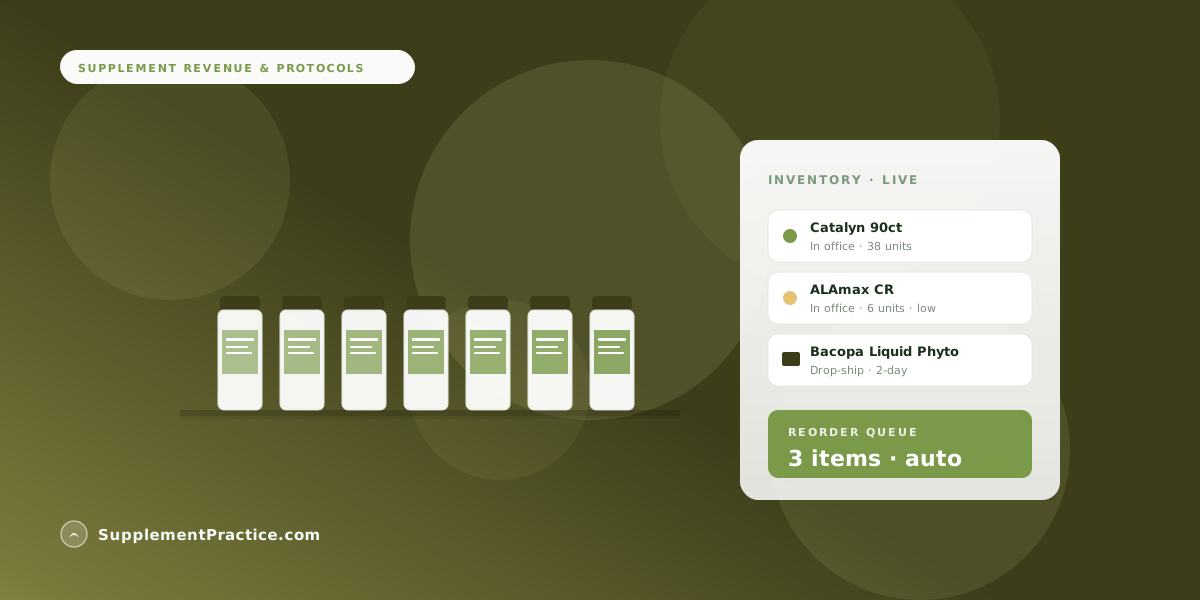
The Standard Process question isn't physical-or-virtual — it's which SKUs go in each bucket. Run a 90-day velocity report; carry the top 20-30 SKUs physically (the high-margin, high-turnover items where same-day adherence pays off); route the long-tail SP catalog through Patient Direct drop-ship. The 5-bottle-per-month rule is the break-even. This article shows the math, the operational rules, and the quarterly review process that keeps the split tuned.
Hybrid Inventory Model — Operating Rules
- Physical stock: SKUs selling 5+ bottles/month over a rolling 90-day window
- Patient Direct: everything below the velocity threshold + long-tail formulations
- Auto-reorder fires at 30-day cover — never deeper (turnover > buffer)
- Per-bottle expiry tracking; flag any unit within 90 days of expiration
- Quarterly review to graduate SKUs between buckets as protocol patterns shift
- Single dashboard for both fulfillment paths; no split spreadsheets
- Target: < 2% inventory value lost annually to expiry
Why pure physical and pure virtual both lose to hybrid
A pure-physical Standard Process dispensary ties up real working capital — typically $15-30K for a single-practitioner clinic, $40-80K for a multi-practitioner one — and exposes the practice to expiration loss on slow-moving SKUs. The capital outlay isn't the worst part. The cognitive overhead of managing 80+ SKUs of physical stock, with reorders, expiry dates, and shelf rotation, becomes a part-time job for someone on staff. Clinics that try to do this with a spreadsheet eventually burn out the front-desk person who inherited it.
A pure-virtual dispensary running entirely through Standard Process Patient Direct gives up two things: roughly 10-15 percentage points of gross margin, and the patient-walks-out-with-bottles experience that drives same-day adherence. Practitioners often underestimate the second loss. The patient who leaves with bottles starts the protocol that night; the patient waiting for a Patient Direct shipment starts it sometime between Thursday and the following Monday, and a non-trivial percentage of patients never start.
The hybrid model captures the margin and adherence of physical carry on the SKUs that justify it, and uses Patient Direct as a release valve for the long tail — which is where pure-physical breaks down anyway. The rest of this piece is the operational detail of how to run the split.
The velocity-margin formula and where the break-even sits
The decision rule is simpler than most clinics make it. For each SKU, compute (1) average bottles sold per month over the trailing 90 days, and (2) the margin delta between physical carry and Patient Direct for that product. Physical carry pencils out when monthly velocity × margin delta × 12 months exceeds the carry cost + expiry risk for the bottle.
The mechanics, with realistic Standard Process numbers:
| Variable | Typical SP value | Notes |
|---|---|---|
| Physical margin | 35-45% | Practitioner wholesale tier; varies by account size. |
| Patient Direct margin | 20-28% | Includes the practitioner rebate; before shipping subsidies. |
| Margin delta | 10-17% | What you give up by going virtual on that SKU. |
| Bottle retail | $25-65 | Skewed by formulation; protomorphogens at the higher end. |
| Carry cost (annualized) | ~5% | Storage + opportunity cost of inventory dollars. |
| Expiry write-off rate | 2-8% | 2% in well-run hybrids, 8%+ in pure-physical with poor turnover. |
Run the formula on a typical fast-mover — say, Catalyn at 12 bottles/month, $30 retail, 15% margin delta: 12 × 30 × 0.15 × 12 = $648 per year of margin captured by carrying physically. Subtract roughly $40 of annualized carry cost and write-off risk, and you net ~$600 on a single SKU. Multiply across 25 fast-movers and the hybrid model is generating $10-15K of incremental margin annually versus going pure-virtual.
Now run the same formula on a slow-mover at 1 bottle/month: 1 × 30 × 0.15 × 12 = $54 of captured margin. The carry cost and expiry risk on the slow-mover — especially on something that might expire before you sell it — easily exceed $54. Pure-virtual is the right answer for that SKU.
The 30-day-cover reorder rule and why deeper is worse
Most clinics that try physical carry set the reorder threshold too deep. The intuition is "don't run out" — so they set it at 60 days of cover, then 90, then 120 because they got burned once. The result is dead inventory and expiry write-offs that wipe out the margin advantage.
The right threshold is a 30-day cover, with two operational guardrails: a same-day visibility check at the practice management dashboard, and an automated reorder action tied to the practitioner's Standard Process account. The 30-day cover gives you enough lead time to receive a reorder before stock-out (SP ships in 2-5 business days to most US locations), without piling up product that ages out on the shelf.
Pair this with electronic reorder. Standard Process supports practitioner-account automation; configure the reorder to fire when a SKU hits 30-day cover at current velocity, not at a fixed bottle count. A fixed bottle count is wrong because velocity shifts seasonally and as the practice grows. A cover-based threshold self-tunes.
4-DC chiropractic clinic, $14K physical SP inventory, 7% expiry write-off
A four-DC clinic running purely physical Standard Process had $14,000 of bottles on the shelf in mid-2025 and a 7% annual expiry write-off — about $1,000 of product written off per year. They were carrying 60+ days of cover on most SKUs because no one had time to chase reorders, so they over-ordered.
The fix was structural, not behavioral. Move bottom-quartile-velocity SKUs (anything selling fewer than 3 bottles/month) to Patient Direct. Set a 30-day-cover auto-reorder on the remaining 28 SKUs. Add per-bottle expiry tracking with a 90-day alert. Six months later the physical inventory carried was $7,800 — 44% less working capital tied up — with the expiry write-off dropping to roughly 1.5% and patient-walk-out fulfillment unchanged. The Patient Direct shift moved roughly 22% of total dispense volume to drop-ship, which the practice underwrote with a "first 30 days of protocol shipped free" patient offer using the recaptured margin.
Net effect: ~$6,200 of capital returned, ~$800/year less in expiry, and a stronger patient-experience story on shipped product.
The quarterly review: how to keep the split tuned
The hybrid model isn't set-and-forget. Practice protocols shift over time — a new practitioner joins and starts prescribing a different brand subset; a board specialty changes the case mix; a Standard Process product reformulation moves demand. The split should be reviewed quarterly, with a velocity report driving the moves.
The review is mechanical: any SKU that crossed the 5-bottle/month line for two consecutive months gets promoted to physical. Any physical SKU that fell below the line for two consecutive months gets demoted to Patient Direct. The 2-month confirmation rule prevents whipsawing on seasonal noise — a one-month bump is usually an artifact, not a trend.
Run the review the second week of each quarter, not the first. The first week's data is always noisy from holiday closes or month-end ordering patterns. The system can produce the velocity report in seconds; the practitioner makes the promote/demote calls in 15 minutes.
Common mistakes
Five anti-patterns we see in hybrid Standard Process dispensaries
- Carrying every SKU "just in case." The 80-SKU dispensary that turns 25 SKUs is paying for storage on 55 bottles a quarter. Velocity-cull twice a year minimum.
- No expiry tracking. Whole-bottle dispense to a patient with 30 days of shelf life remaining is a complaint waiting to happen. Track per bottle, not per SKU.
- Patient Direct as second-class citizen. Some practices treat Patient Direct fulfillment as "less than" physical — they don't message patients clearly about shipping windows or first-protocol expectations. Drop-ship works when you set up the experience deliberately.
- Reorder thresholds in bottles, not in days-of-cover. A "reorder at 3 bottles" rule fails when the SKU's velocity doubles. Days-of-cover self-tunes.
- Letting front desk own the spreadsheet without integration. If inventory lives in a Google Sheet the Co-Pilot can't read, the AI will keep recommending products you can't fulfill.
Frequently asked questions
Should I carry Standard Process physically or use Patient Direct exclusively?
Neither pure model wins. Hybrid almost always does — carry the top 20-30 SKUs by velocity physically, drop-ship the long tail through Patient Direct. The break-even sits around 5 bottles/month per SKU; above it, physical pencils out, below it, drop-ship is cheaper.
What's the margin difference between physical and Patient Direct?
Physical carry yields roughly 35-45% gross margin to the practitioner; Patient Direct typically yields 20-28%. The 10-15 point gap is real money on high-velocity SKUs and irrelevant on items that sell 1-2 bottles a year.
How do I decide which 20-30 SKUs to carry physically?
Run a 90-day velocity report from your protocol history. The cutoff isn't a fixed number — it's the inflection point where bottles-sold-per-month drops below 5. Above the line: physical. Below: Patient Direct. Re-run quarterly.
How do I avoid expiry write-offs on physical Standard Process stock?
Three rules: 30-day-cover auto-reorder (not 60), per-bottle expiry tracking with a 90-day alert, and never stock more than 6 weeks of expected velocity. The combination keeps expiry write-offs under 2% of inventory value.
Can I run a virtual-only Standard Process dispensary?
Yes — Patient Direct supports a fully virtual model. The trade-offs are clear: 10-15 lower margin points, 2-4 days between protocol approval and product arrival, and the loss of the walk-out-with-bottles experience. Sensible for brand-new practices testing demand; suboptimal for established clinics.
Does it make sense to add a second brand alongside Standard Process?
Yes. No single brand covers every clinical category cleanly, and brand redundancy on common categories prevents single-brand stockouts from breaking protocols. Gaia Herbs PRO, Designs for Health, and Xymogen complement Standard Process well at the formulation level.
Where to go next
Three companion pieces: how real-time inventory binds to AI-drafted regimens, the case for a virtual-only dispensary if you're starting from scratch, and how the Clinical Co-Pilot drafts protocols against the brands you stock. Supplement Practice tracks both fulfillment paths in one inventory dashboard, with per-bottle expiry, days-of-cover reorder thresholds, and the velocity report that drives the quarterly review.