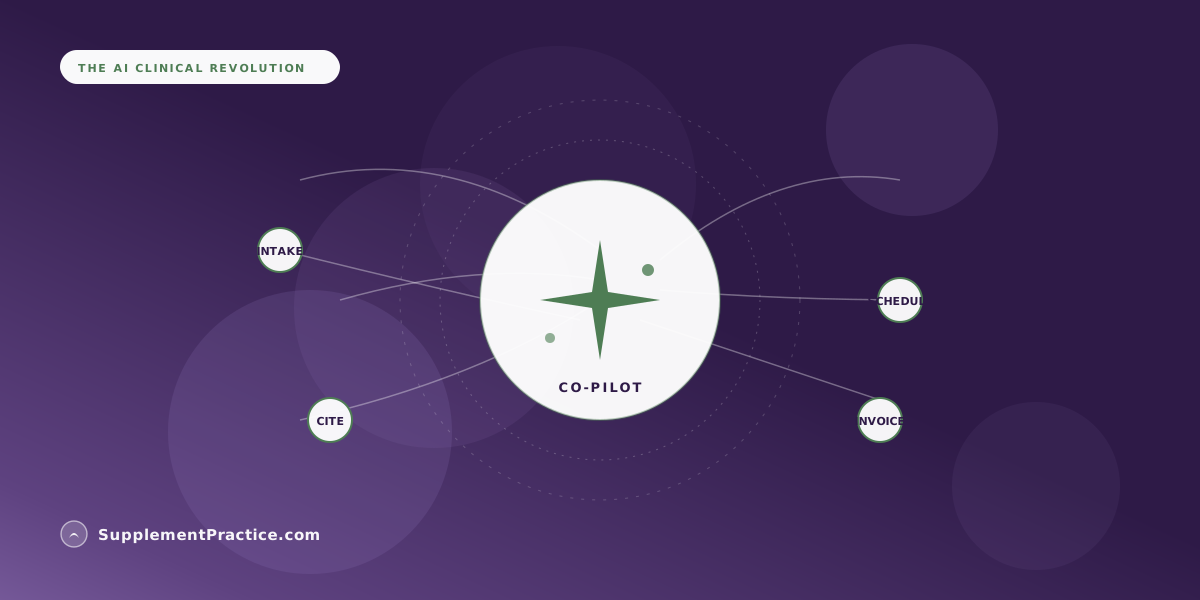
An AI Clinical Co-Pilot drafts evidence-based supplement protocols in under 60 seconds by retrieving from a structured brand catalog — not by generating from scratch. The practitioner still owns three decisions the AI can't make: clinical priority, dosing window, and drug-nutrient screen. This is a step-by-step workflow with the override checkpoints every clinician should hold.
What an Evidence-Based AI Protocol Includes
- Brand-specific SKU + dose, not generic "take magnesium"
- Clinical rationale tied to specific intake findings
- Citations to brand monographs and durable references (NIH ODS, LPI)
- Drug–nutrient interaction screen against the patient's medication list
- AM/PM schedule with bottle-supply math for the protocol length
- Audit trail of every AI suggestion, override, and final approval
- Pricing transparency: what the patient actually pays
The bottleneck isn't writing the protocol — it's defending it
Most practitioners who say they want AI to "build protocols faster" are misdiagnosing their own workflow. The 25 minutes a typical chiropractor or functional medicine practitioner spends per protocol isn't typing time. It's the cycle of: cross-reference the patient's intake against your mental model, scan three or four brand catalogs for the right SKU, look up a dosing window you haven't used in six months, screen the patient's medication list, and write everything down in a format the patient can actually follow.
An AI Clinical Co-Pilot collapses the first four steps. It cannot, and should not, collapse the last one — the practitioner's signature. The right mental model isn't "AI replaces clinical judgment." It's "AI hands you a senior-resident write-up; you're still the attending."
Evidence quality is set by the catalog, not the model
A generic large language model will confidently recommend "Designs for Health Magnesium Buffered Chelate 200 mg twice daily" — and there is a real chance no such SKU exists at that dose. The model isn't lying; it's pattern-matching on the shape of likely SKUs. This is the single most important failure mode practitioners need to understand before they trust any AI tool with clinical work.
The fix is retrieval-augmented generation against a verified catalog. Supplement Practice's Clinical Co-Pilot retrieves from the live SKU databases of Standard Process, Gaia Herbs PRO, Xymogen, Metagenics, Designs for Health, Food Research, Premier Research Labs, MediHerb, and Doctors' Research before composing a protocol — so the model cannot return a product that doesn't exist, and dosing is constrained to the bottle-realistic strengths actually on the market. The practitioner sets which brands their clinic carries; the Co-Pilot only recommends from that subset.
This is the practical meaning of "evidence-based" in an AI context. Not that the model has read every paper on PubMed — it hasn't, and even if it had, it couldn't tell you whether the catalog you stock includes the molecule those papers studied. Evidence-based means: the recommendation maps to a real product, at a real dose, with a real monograph the practitioner can click into and verify.
The 6-step workflow from intake to printed schedule
Once the catalog grounding is in place, the practical workflow looks like this:
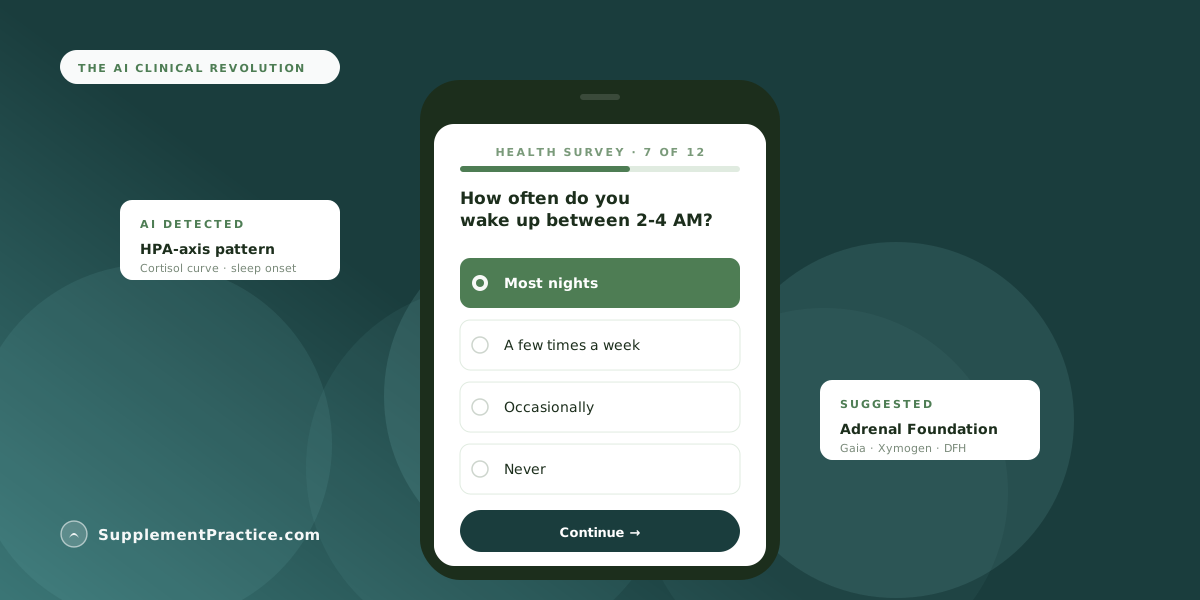
- Patient completes a structured intake. Symptom severity scales, medication list, lab uploads, prior protocols, lifestyle. The richer the intake, the better the Co-Pilot's first draft.
- Co-Pilot clusters root causes. Not just symptom-to-supplement matching — the model identifies the underlying pattern (HPA dysregulation, gut dysbiosis, methylation, mitochondrial dysfunction) and groups supplements by mechanism.
- Co-Pilot drafts the protocol. Each product appears with: brand SKU, dose, timing, clinical rationale, citation, and any interaction flags from the patient's medication list.
- Practitioner overrides. Swap brands. Adjust doses. Remove products. Add a product the model missed. Every change is logged.
- System computes the schedule. AM/PM stack, with bottle math: "Garlic Forte, 1 AM + 2 PM = 3/day × 60-day protocol = 3 bottles needed." This is where most clinicians used to lose time.
- One-click print, email, and chart. The patient gets a printable schedule. The chart gets a note. Inventory deducts the dispensed bottles. The invoice generates.
Routine cases — a single complaint, no polypharmacy — clear in under 60 seconds. Complex cases that took 30+ minutes manually settle around 5–7 minutes including all overrides, because the friction has moved from "what should I prescribe" to "do I agree with this draft."
47-year-old perimenopausal patient with HPA dysregulation
Chief complaints: 3 AM awakenings, afternoon fatigue, new anxiety, lighter and irregular cycles. Medications: levothyroxine 50 mcg, sertraline 50 mg. Recent labs: morning cortisol 22 mcg/dL (high-normal), DHEA-S 70 (low), free T3 2.4 (low-normal), ferritin 28.
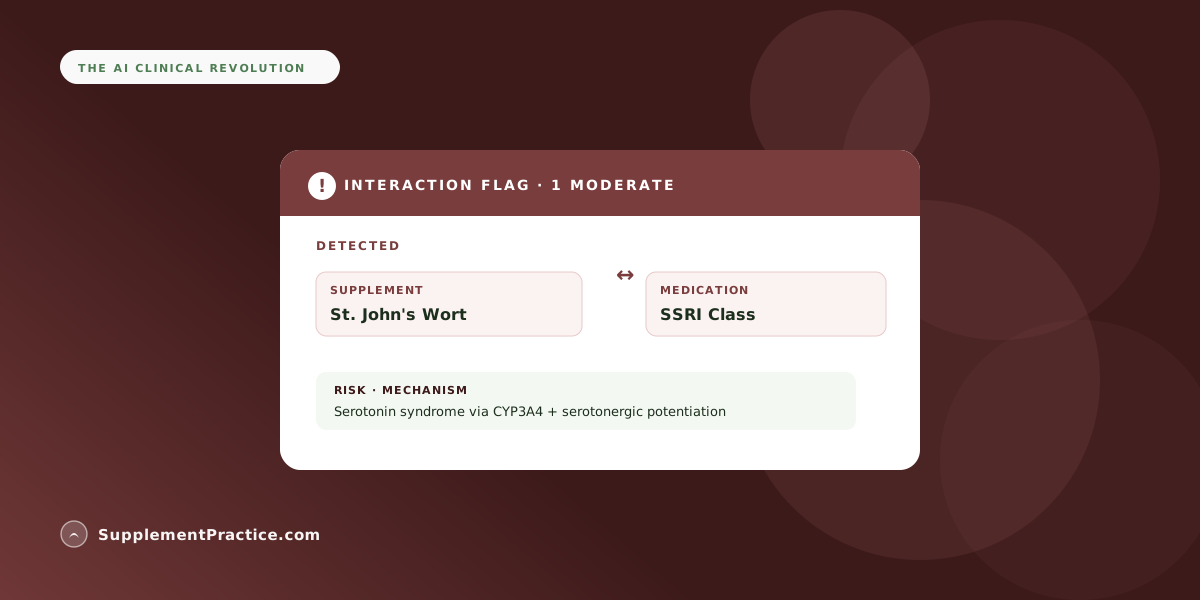
The Co-Pilot draft, in 40 seconds: Standard Process Min-Chex® (1 AM) for nervous-system tone, Gaia Herbs PRO Ashwagandha Root 500 mg (1 PM, away from levothyroxine by 4+ hours) for HPA recalibration, Designs for Health Iron-C 28 mg (1 with breakfast) for ferritin, Xymogen Methyl Protect (1 AM) for methylation support given peri-menopause. Drug-interaction flag surfaced for St John's Wort with sertraline (not recommended, excluded). Iron timing flagged away from levothyroxine.
Practitioner override: dropped Methyl Protect (wants methylation labs first), swapped Iron-C to Standard Process Ferrofood (whole-food preference), added Cataplex® B at 2/day for B-vitamin support. Total elapsed time including overrides: 3 minutes 40 seconds. The schedule, invoice, and chart note were finalized with one click.
Where the practitioner still owns the decision
Three checkpoints belong to the human, not the model — and any tool that hides these from the practitioner is the wrong tool.
Clinical priority. The Co-Pilot can identify five root causes from a complex intake. It doesn't know which one needs to be addressed in the first 30 days and which can wait until the follow-up. That sequencing decision is practitioner judgment, informed by the patient's bandwidth, budget, and severity.
Dosing window. The model defaults to mid-range therapeutic doses. A patient with prior bowel sensitivity may need to start at 25% and titrate. A patient with active deficiency may need a 2–4 week loading dose. The Co-Pilot will recommend a reasonable starting point; the practitioner decides whether to compress or extend the ramp.
Drug-nutrient screen depth. Automated screens catch the well-documented interactions (warfarin–vitamin K, levothyroxine–calcium/iron, SSRIs–St John's Wort, statins–CoQ10 depletion). They will miss subtler issues — a patient on a CYP2D6 inhibitor where the supplement metabolizes through that pathway, or cumulative serotonergic load from 5-HTP + SAMe + an SSRI. The practitioner reviews the full medication list and overrides where appropriate.
A note on dosing ranges the Co-Pilot will surface
| Nutrient | Typical therapeutic range | Where the override usually happens |
|---|---|---|
| Magnesium glycinate | 200–400 mg elemental, PM | Start at 100 mg if GI-sensitive; titrate weekly. |
| Vitamin D3 | 2,000–5,000 IU/day; loading dose if 25(OH)D < 30 ng/mL | Always pair with K2 MK-7 if > 4,000 IU sustained; verify 25(OH)D before megadose. |
| Omega-3 (EPA+DHA) | 1–2 g/day; 2–4 g for inflammatory states | Check anticoagulant use; flush-free fish oil for SSRI patients (less GI distress). |
| Methylated B-complex | 1 capsule/day | Reduce or fractionate for known MTHFR sensitivity / over-methylation phenotype. |
| Ashwagandha (KSM-66, Sensoril) | 300–600 mg/day | Avoid in thyroid storm risk; PM dosing for sleep, AM for stamina. |
| Zinc picolinate | 15–30 mg/day with food | Pair with 2 mg copper if > 30 days; not on an empty stomach. |
These are the most-frequently-overridden defaults across the practitioners we work with. The Co-Pilot will surface a reasonable starting point in each case; the override happens because the practitioner knows something about this patient the intake didn't capture.
Common mistakes when first handing off to an AI Co-Pilot
Five anti-patterns we see in the first 30 days
- Trusting the first draft without override. The point isn't to accept what the Co-Pilot writes; it's to use the draft as a starting line. Practitioners who never override are leaving clinical judgment on the table.
- Skipping the brand filter. If you don't tell the system which brands your practice carries, the Co-Pilot will recommend SKUs you can't dispense. Set the filter once during onboarding.
- Treating the AI rationale as a citation. The Co-Pilot's "because zinc supports immune function" sentence isn't a citation — the linked monograph or PubMed entry is. Read the link, not the paraphrase, when stakes are high.
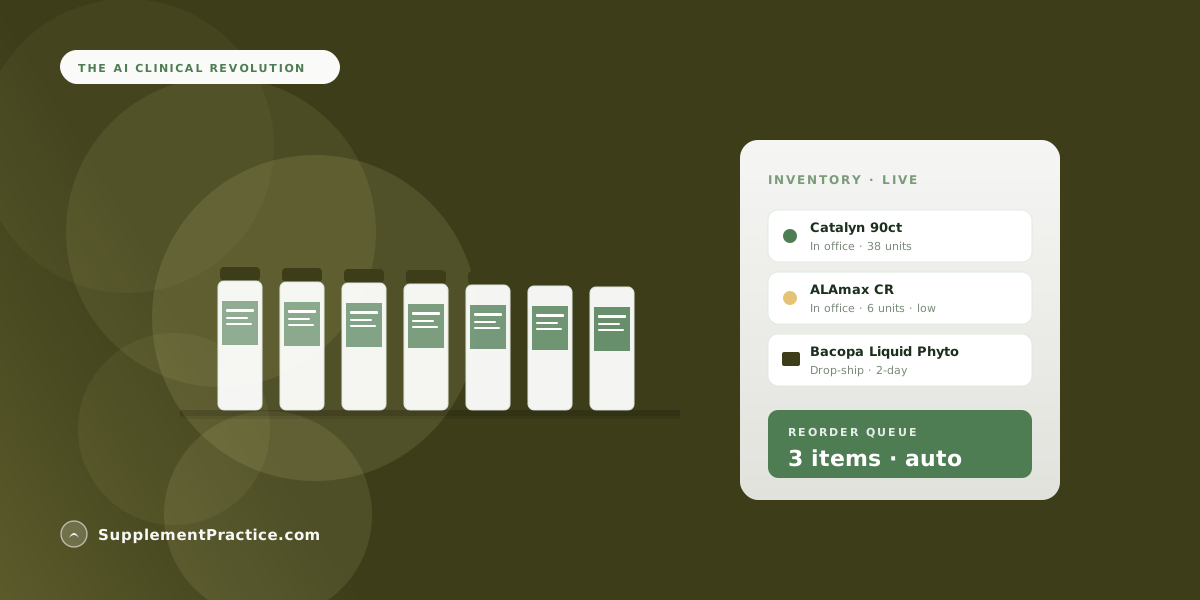
- Ignoring the inventory flag. A Co-Pilot that recommends 3 bottles of a SKU you have 1 of in stock will frustrate the patient. Real-time inventory linkage is a feature, not a nice-to-have.
- Not building a feedback loop. The Co-Pilot improves when the practitioner's overrides are captured. If your tool doesn't log overrides, switch tools.
What "evidence-based" should actually mean in 2026
Most marketing copy uses "evidence-based" to mean "we read some studies." In a clinical context, the bar is higher: the recommendation must be (1) traceable to a verified product, (2) supported by a citation a practitioner can audit, (3) screened against this specific patient's medications, and (4) documented in a chart that defends the practitioner's decision after the fact.
The Institute for Functional Medicine has been explicit that decision-support tools belong inside the clinical workflow, not outside it — that AI accelerates the practitioner, it does not replace them (IFM). The Linus Pauling Institute's Micronutrient Information Center remains the most accessible second-opinion reference for the dosing ranges any Co-Pilot will surface (LPI MIC). For drug-nutrient screening, the NIH Office of Dietary Supplements maintains the canonical interaction fact sheets (NIH ODS Health Professional Fact Sheets).
When an AI Co-Pilot is grounded in those three layers — verified catalog, durable references, patient-specific screen — and the practitioner stays in the loop on the three decisions above, the time savings are real and the evidence trail is stronger than what most practices produce manually.
Frequently asked questions
Can an AI Co-Pilot really replace clinical judgment in protocol building?
No — and any vendor claiming it can should worry you. An AI Co-Pilot drafts and cites; the practitioner verifies dose, screens for drug interactions, and signs off. The right mental model is a senior resident handing you a write-up: it saves you time, it doesn't replace the attending.
How does an AI Co-Pilot avoid hallucinating supplements that don't exist?
By grounding every recommendation in a structured product catalog. Supplement Practice's Co-Pilot retrieves from the live SKUs of Standard Process, Gaia Herbs PRO, Xymogen, Metagenics, Designs for Health, Food Research, Premier Research Labs, MediHerb, and Doctors' Research — meaning the LLM cannot return a product that isn't in the catalog, and dosing is constrained to bottle-realistic ranges.
What's the difference between an AI Co-Pilot and ChatGPT for supplement protocols?
ChatGPT is a generalist LLM with no catalog grounding, no drug-nutrient interaction database, no patient context, no audit trail, and no HIPAA-eligible deployment. A clinical Co-Pilot retrieves against verified brand monographs, screens against the patient's medication list, and logs every suggestion to the chart.
How long does AI-assisted protocol building actually take?
Routine protocols (single complaint, simple medication list) typically take under 60 seconds from intake submission to printable schedule. Complex cases — multi-system, polypharmacy, recent labs to interpret — take 3–7 minutes including the practitioner's overrides, versus 20–45 minutes manually.
Does the AI Co-Pilot screen for drug-nutrient interactions?
Yes. When the patient's medication list is in the chart, the Co-Pilot cross-references each proposed supplement against the same interaction databases practitioners use manually (e.g., SSRI–St John's Wort, warfarin–vitamin K, levothyroxine–calcium timing). Flagged combinations are surfaced before the protocol is finalized.
Where does liability sit when an AI Co-Pilot drafts a protocol?
With the practitioner who signs and dispenses, in every jurisdiction we've reviewed. The Co-Pilot is decision-support — the same legal posture as a clinical reference textbook or a UpToDate query. The audit trail of every AI suggestion is preserved in the chart, which strengthens defensibility, not weakens it.
Where to go next
If you're evaluating AI for protocol building, three related reads will save you cycles: how AI handles complex patient health surveys (the intake side of this workflow), how real-time inventory data shapes the protocols the Co-Pilot will recommend, and how AI screens for drug-supplement interactions in patients on polypharmacy.
Clinical & Technical References
- Institute for Functional Medicine — Practitioner Resources
- Linus Pauling Institute — Micronutrient Information Center
- NIH Office of Dietary Supplements — Health Professional Fact Sheets
- Standard Process — Clinical Research Library
- Xymogen — Practitioner Clinical Resources
- Gaia Herbs Professional — Herbal Monographs
- Cochrane Library — Systematic Reviews