Supplement-drug interaction screening is the single highest-leverage application of AI inside a functional medicine practice — not because the interactions are rare (they're common in polypharmacy patients) but because manual screening at the volume a practice runs is operationally impossible. An AI Clinical Co-Pilot screens every supplement against every active medication in real time, classifies the interaction by severity, surfaces the specific mitigation, and logs the practitioner's response for chart documentation. This piece walks through how the system actually works and where practitioner judgment still owns the call.
High-Frequency Supplement-Drug Interactions the AI Catches
| Supplement | Medication | Severity | Mitigation |
|---|---|---|---|
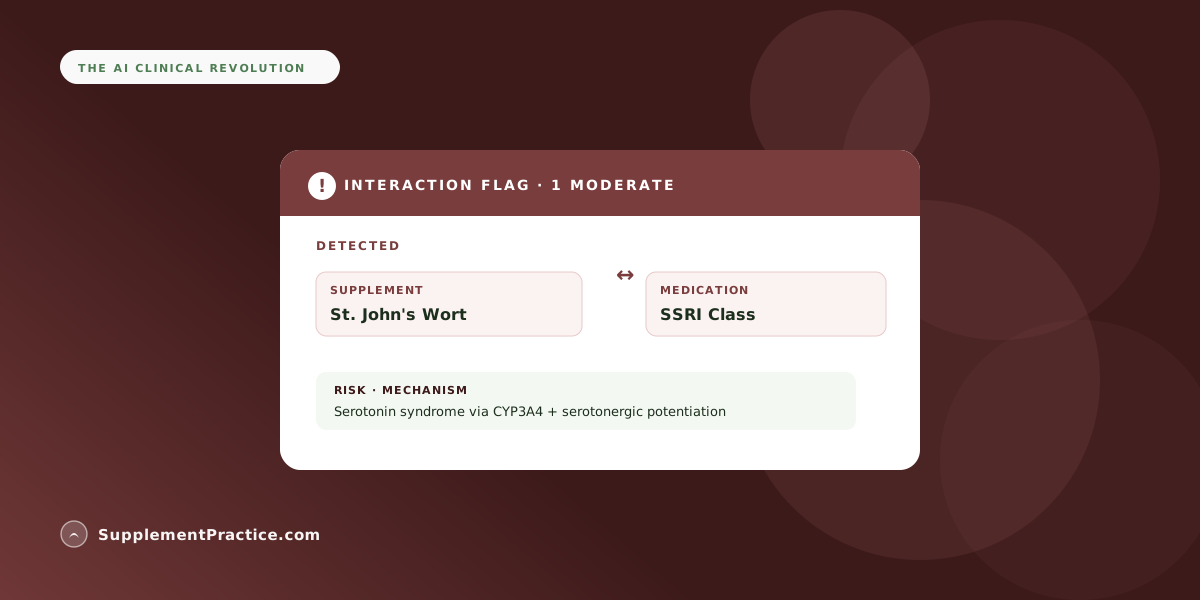
| St. John's Wort | SSRIs, MAOIs | Severe | Do not combine |
| Vitamin K (high-dose) | Warfarin | Severe | Maintain consistent intake; INR monitoring |
| Calcium | Levothyroxine | Moderate | 4-hour separation |
| Iron | Levothyroxine | Moderate | 4-hour separation |
| Magnesium | Tetracycline / Fluoroquinolone | Moderate | 2-hour separation |
| High-dose Niacin | Statins | Moderate | Monitor for myopathy |
| CoQ10 | Warfarin | Mild-Moderate | Verify INR stability after addition |
| Ginkgo, Garlic, Ginger | Anticoagulants | Mild-Moderate | Antiplatelet additive risk; document review |
The volume problem manual interaction screening cannot solve
A practitioner running 25 supplement-protocol visits per week, with patients averaging 4 active medications and 6 supplements, is performing roughly 600 supplement-drug pairings per week. Doing this manually — looking up each pairing in a reference database — takes 4-8 minutes per check at minimum. That's 40-80 hours of weekly screening time, which no clinician has. So in practice, manual interaction screening doesn't happen comprehensively. Practitioners check the obvious flags (St. John's Wort, warfarin), trust general knowledge for the rest, and accept that some interactions slip through.
The cost of the slips is borne by patients. A levothyroxine patient who takes calcium with their morning thyroid pill loses 30-40% of the medication's absorption. A patient on warfarin who adds 1g of vitamin C daily probably doesn't notice the modest antioxidant effect on warfarin metabolism; a patient on warfarin who adds high-dose vitamin E or ginkgo might end up in an emergency department with bleeding. The screening is the kind of work humans are bad at and computers are excellent at.
What the AI is actually doing under the hood
The Clinical Co-Pilot's interaction screen is conceptually simple but operationally substantial. When a supplement is added to a patient's protocol, the system pulls the patient's active medication list from the chart and runs a pairwise check against an integrated interaction database. The database stack typically includes Lexicomp-equivalent mappings for documented drug-supplement interactions, the NIH Office of Dietary Supplements interaction lists for the most-studied nutrients, plus brand-specific safety advisories the manufacturer publishes.
The check happens in milliseconds and returns either "no flag" (the supplement can be added without interaction concern), "informational flag" (theoretical interaction, low clinical relevance — surfaces but doesn't block), "moderate flag" (combine with a specific mitigation like timing separation), or "severe flag" (do not combine without explicit practitioner override and documented rationale).
The output isn't a yes/no decision — it's structured information the practitioner uses to make the decision. Mechanism, severity, mitigation, source citation, and the audit-trail entry that gets logged to the chart regardless of how the practitioner responds.
The six interactions that dominate flag volume in real practices
Across the practitioners we work with, six interactions account for roughly 70% of clinically relevant flags. Knowing these by heart is part of competent practice; the AI catches them, but the practitioner should also know them.
St. John's Wort + SSRIs (severe). Additive serotonergic risk; potential serotonin syndrome. Do not combine. The AI hard-blocks this and requires explicit override documentation if the practitioner has clinical reason to override.
Vitamin K + warfarin (severe). The patient's INR is calibrated to their typical dietary and supplemental vitamin K intake. Sudden changes — either direction — disrupt anticoagulation. The clinical guidance isn't "no vitamin K" but "consistent vitamin K intake;" the AI surfaces the consistency requirement.
Calcium + levothyroxine (moderate). Calcium impairs levothyroxine absorption. The mitigation is timing: 4-hour separation between the levothyroxine dose and any calcium-containing supplement. The same applies to iron and to some extent magnesium.
Iron + levothyroxine (moderate). Same absorption-window mechanism as calcium. 4-hour separation. Particularly relevant for the perimenopausal patient population that frequently overlaps with thyroid dosing.
CoQ10 + warfarin (mild-moderate). CoQ10 has a structural similarity to vitamin K that produces modest anticoagulation modulation. Practical advice: verify INR stability 2-4 weeks after adding CoQ10 to a warfarin patient's regimen. Most patients tolerate the combination without issue, but the verification is the safe posture.
High-dose niacin + statins (moderate). Additive myopathy risk. The mitigation is monitoring for muscle pain/weakness and CK if symptoms emerge; not a blanket "don't combine."
Severity classification and what practitioners do with each tier
The three-tier severity classification maps directly to practitioner workflow.
Severe flags hard-block the supplement from being added to the protocol. The practitioner can override, but the override requires explicit documentation of the clinical rationale ("patient previously tolerated combination at low dose under MD coordination"). The override is logged to the chart with the practitioner's name and timestamp. This creates a defensibility audit trail that's stronger than most manual documentation.
Moderate flags surface a recommended mitigation — timing separation, monitoring requirement, dose modification — without blocking the supplement. The practitioner reviews the mitigation and decides whether to incorporate it. Most moderate flags become a simple instruction in the patient's printed schedule: "Take this product at least 4 hours away from your morning thyroid medication."
Mild / informational flags surface as visible-but-non-blocking annotations. The practitioner sees them, decides whether the theoretical risk is clinically relevant for this patient, and proceeds. Most mild flags are dismissed without action because the underlying interaction has weak evidence or low clinical relevance.
71-year-old patient on warfarin + levothyroxine + simvastatin, supplement protocol composed in 3 minutes
A 71-year-old patient on warfarin (INR target 2-3), levothyroxine 75 mcg, simvastatin 20 mg, and metformin presented for nutritional support — fatigue, peripheral neuropathy symptoms (likely B12/methylation related), and recurring constipation. Practitioner wanted to add CoQ10 (statin patient), B-complex with active B12 and folate (methylation/neuropathy), magnesium glycinate (constipation, sleep), and Tuna Omega-3 (cardiovascular).
The Co-Pilot's automatic interaction screen surfaced four flags. (1) Magnesium glycinate at the proposed dose required 2-hour separation from her morning levothyroxine; the schedule was set to magnesium with dinner. (2) CoQ10 + warfarin flagged as mild-moderate; the practitioner added "INR recheck in 3 weeks" to the chart. (3) High-dose Tuna Omega-3 + warfarin flagged as mild antiplatelet additive; documentation note added, no dose change. (4) Active folate methylcobalamin showed no warfarin interaction concern.
Total elapsed time from intake submission to protocol approval: 3 minutes 20 seconds. Three of the four flags would likely have been missed in manual review by a practitioner this busy; the audit trail captured every decision. INR recheck at 3 weeks confirmed stability; protocol continued.
Where the AI screen still requires practitioner override
Three categories of clinical judgment the AI can't make and shouldn't try to.
Cumulative effects across multiple herbal products. The AI checks pairwise interactions reliably. Cumulative serotonergic load from 5-HTP + SAMe + an SSRI, or cumulative anticoagulant effect from omega-3 + ginkgo + ginger + garlic in the same patient, is multi-product reasoning the practitioner owns.
Patient-specific tolerance history. A patient with documented tolerance for a flagged combination from prior protocols may proceed where the AI would default to blocking. The practitioner's chart knowledge overrides the database default.
Off-label dose escalation. Most interaction databases use typical retail-dose assumptions. At clinical or therapeutic doses (high-dose vitamin C IV-equivalents, high-dose magnesium for migraine, etc.), interaction profiles can shift. The practitioner verifies for the off-label dose.
What happens when the medication list is incomplete
The AI can only screen against what's in the chart. The single most common failure mode of supplement-drug interaction screening — manual or automated — is an incomplete medication list. Patients forget OTCs, forget supplements they've been taking long-term, forget medications they discontinued recently, forget medications they take occasionally.
The structural mitigation is a forced medication reconciliation step at every visit. Before the practitioner composes a new protocol, the system prompts: "Please confirm the patient's current medications. Last reconciled: [date]." The patient sees the medication list on screen and confirms it's accurate. This 30-second step catches roughly 15-20% of interaction risks that would otherwise slip through because the chart was stale.
Common mistakes
Five anti-patterns in supplement-drug interaction workflows
- Skipping the medication reconciliation step. The most reliable AI screen is worthless if the chart's medication list is stale.
- Treating AI flags as binary. The severity classification matters. Severe is "don't do this"; moderate is "do this with mitigation"; mild is "be aware." Treating them all the same wastes practitioner attention.
- Overriding without documentation. Severe-flag overrides should always carry a documented rationale. The audit trail protects the practitioner if the patient has an adverse event.
- Not communicating mitigations to the patient. "Take this 4 hours away from your thyroid medication" needs to land in the patient's printed schedule, not just in the practitioner's head.
- Trusting AI for cumulative-effect reasoning. Pairwise checks are reliable; multi-product cumulative risk reasoning is practitioner work.
Frequently asked questions
What database does the AI use to screen supplement-drug interactions?
Lexicomp-equivalent mappings for documented interactions, NIH ODS interaction lists, and brand-specific safety advisories. The screen runs at the moment a supplement is added, against every active medication in the chart.
What are the highest-frequency interactions the AI catches?
Six dominate roughly 70% of clinically relevant flags: St. John's Wort + SSRIs, Vitamin K + warfarin, Calcium + levothyroxine, Iron + levothyroxine, CoQ10 + warfarin, and high-dose Niacin + statins.
How are interactions classified by severity?
Three tiers. Severe: hard-block with explicit override required. Moderate: surface with specific mitigation (timing separation, monitoring). Mild: informational only.
Does AI screening replace pharmacist consultation?
No. For complex polypharmacy (5+ chronic medications), pharmacist consult remains valuable for rare interactions and judgment calls on timing/dose. AI catches high-frequency well-documented interactions; pharmacist consult handles the long tail.
What happens when the patient's medication list is incomplete?
The AI can only screen what's in the chart. Mitigation is a forced medication reconciliation step at every visit before protocol composition.
How are flagged interactions documented for malpractice defensibility?
Every flag is logged with timestamp, interaction text, severity, citation source, practitioner response, and rationale if overridden. This is stronger documentation than most practices produce manually.
Where to go next
Three companion pieces: the broader AI Clinical Co-Pilot workflow that includes interaction screening, protocols for healthy aging where polypharmacy interactions are most common, and how the Co-Pilot replaces manual supplement research at clinic scale. Supplement Practice runs the interaction screen automatically on every protocol composition with full chart-level audit trail.