Naturopaths make money beyond office visits primarily through a professional supplement dispensary, which typically carries a 30-100% markup over practitioner cost, plus recurring refill revenue, membership or care-plan retainers, and virtual consults. The dispensary is usually the single largest non-visit stream because it monetizes recommendations the naturopath already makes.
Naturopathic Income Beyond the Exam Room
- A professional dispensary typically runs a 30-100% markup over practitioner cost
- Automated supplement refills convert one-time sales into predictable monthly revenue
- Membership and care-plan retainers smooth cash flow between visits
- Group programs and workshops earn per-head instead of per-hour
- Virtual consults extend your reach past a local drive radius
- Lab review and interpretation packages monetize expertise, not just chair time
- Bundling protocols with the products that fulfill them raises average order value
The exam-room hour is a ceiling, and every growing practice eventually hits it
There are only so many hours a naturopath can bill face-to-face, and pricing them higher only goes so far before patients balk. The practices that break past a personal income plateau do it by earning from the value they create between visits — the protocols, the products, the follow-up — rather than only from the minutes they sit across from someone. None of this requires abandoning clinical care. It requires capturing the revenue that already flows out the door when a patient walks to a retail store to buy the exact supplements you just recommended.
Below are the streams that actually move the needle, ranked roughly by how much they contribute for a typical solo-to-small naturopathic practice, along with the mechanics that make each one work.
A professional supplement dispensary is usually the biggest lever
The single largest non-visit revenue source for most naturopaths is a professional-line dispensary. You are already telling patients which nutrients, botanicals, and formulas to take; a dispensary simply lets you fulfill that recommendation at a clinical margin instead of sending the sale to a retailer or an online marketplace. Practitioner pricing on professional brands such as Standard Process, Xymogen, Metagenics, and Designs for Health typically lands 30-100% below the retail-equivalent price you can charge, and that spread is your gross margin.
The difference between a dispensary that adds a little and one that adds a lot is friction. If ordering is a clipboard and a phone call, patients leak to Amazon. If the recommended protocol converts to a cart in one click and ships to the patient's door, capture rate climbs. This is where a real system matters — our guide to starting and running a supplement dispensary business walks through the virtual-versus-physical decision, and tracking the spread in real time is its own discipline, covered in tracking supplement profit margins.
Automated refills turn one sale into a subscription
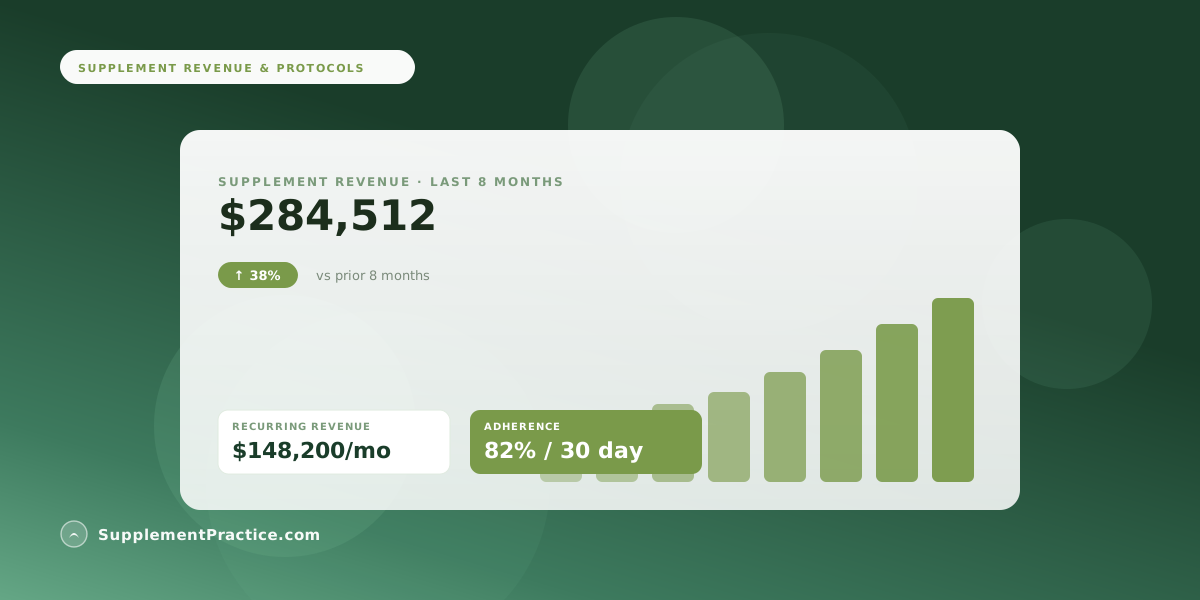
A single bottle sold is a transaction. The same bottle on a 30- or 60-day auto-refill is recurring revenue, and recurring revenue is what makes a practice's income predictable enough to plan around. Chronic-care patients — thyroid support, gut repair, cardiometabolic protocols — often stay on core products for months, and the naturopaths who set up refills at the point of recommendation, rather than hoping the patient remembers to reorder, keep that revenue instead of losing it to attrition.
The compounding effect is real: a modest active-patient panel each holding two or three recurring products becomes a monthly baseline that arrives whether or not the schedule is full. The mechanics of building this are laid out in building a recurring revenue model through automated refills. The subtle benefit is psychological as much as financial: knowing a predictable baseline lands each month lowers the pressure to overbook the calendar, which is exactly the pressure that burns naturopaths out. Recurring product revenue buys you room to practice at a sustainable pace rather than chasing every open slot.
Care plans and memberships pay you for the relationship, not the minute
Naturopathic care is rarely a single visit — it is a relationship measured in months. Packaging that relationship as a membership or a defined care plan (for example, a 90-day metabolic reset with a set number of visits, messaging access, and a supplement allowance) shifts you off the hourly treadmill. Patients get clarity on cost and commitment; you get smoother cash flow and a reason to stay engaged between appointments. Bundling the plan with the products that fulfill it also lifts average order value without a hard sell, because the supplements are simply part of the program the patient already bought.
Virtual consults and group programs multiply your reach
Two levers break the geographic and one-to-one limits of the exam room. Virtual consults let you serve patients outside your drive radius and fill cancellation gaps with clients who would never have appeared on your local schedule. Group programs — a cohort-based cleanse, a small-group hormone series, a workshop — earn per head instead of per hour, so ten people in a room pay ten times for the same block of your time. Both depend on smooth scheduling and clean online payment; see appointment scheduling software for wellness practices for the operational side.
A solo naturopath in Oregon rebuilds around non-visit revenue
Dr. Lena Ostrander ran a full but flat practice — roughly 22 visits a week, income capped by her calendar. She had always written supplement recommendations on paper and told patients to “pick them up wherever.” Over one quarter she moved her recommendations into a virtual dispensary inside Supplement Practice, set her core protocols to convert to a one-click cart, and enabled 30-day refills on the products chronic patients stayed on.
She did not add a single appointment. Within four months her dispensary and refill revenue equaled roughly a third of her visit income, and — because refills recur — that third arrived whether or not a given week was fully booked. The change was not working more hours; it was capturing sales that had been walking out the door.
Lab review and interpretation packages monetize expertise, not chair time
A quieter but genuinely profitable stream is charging directly for the interpretive work you already do. Many patients — and clients of other providers — will pay a flat fee for a structured functional-lab review: you read the panel, write up findings, and hand back a clear protocol and next steps. Because the deliverable is your analysis rather than a block of appointment time, it scales better than the hourly visit and can be offered to people who are not yet full patients. It is also a natural on-ramp: a lab-review client who values your read often converts into ongoing care and a dispensary customer.
The same logic extends to written protocols and second-opinion reviews. Packaging expertise as a defined, priced deliverable — with the supplement recommendations fulfilled through your dispensary — turns knowledge you give away in conversation into a product line. It also documents your reasoning cleanly, which is easier when charting and protocols live in one record; see charting software for integrative and naturopathic practices.
How the streams compare
| Revenue stream | Typical margin / model | Predictability |
|---|---|---|
| Professional dispensary | 30-100% markup over practitioner cost | Medium — tracks recommendations |
| Automated refills | Same margin, recurring monthly | High — subscription-like |
| Membership / care plans | Fixed retainer per patient | High — contracted |
| Group programs | Per-head, low marginal cost | Medium — cohort-based |
| Virtual consults | Per-visit, wider reach | Medium — fills gaps |
| Lab review packages | Flat fee for interpretation | Low-medium — episodic |
Common mistakes that leave money on the table
Where naturopaths lose the non-visit revenue they earned
- Sending the sale away. Writing a recommendation on paper and telling patients to buy “wherever” hands your margin to a retailer for products you selected.
- No refill capture. Selling one bottle and hoping the patient reorders converts recurring revenue into a coin flip; set the refill at the point of sale.
- Pricing only by the hour. Refusing to package care into plans keeps you on the exact treadmill you are trying to escape.
- Ignoring the margin math. Not tracking practitioner cost versus your price means you cannot tell which products actually pay, so you guess.
- Treating compliance as optional. Selling supplements and handling health data still carries advertising and privacy obligations; skipping them creates risk that can erase a year of margin.
A note on rules, taxes, and scope
Naturopathic scope of practice, the ability to dispense or sell products, sales-tax treatment of supplements, and licensing all vary considerably by state and change over time. Treat everything here as general business guidance, not legal or tax advice, and verify dispensary, sales-tax, and scope questions with your state naturopathic board and a qualified CPA or attorney before you build. The revenue model is durable; the specific rules that govern it are local.
Frequently asked questions
What is the most profitable revenue stream for a naturopath?
For most naturopaths the professional supplement dispensary is the largest non-visit stream, because it monetizes recommendations you already make at a 30-100% markup over practitioner cost. Automated refills make that revenue recurring, which is what makes it dependable.
Can naturopaths sell supplements to patients legally?
In most states naturopaths can dispense and sell professional supplements, but scope-of-practice and sales-tax rules vary by state and change. Verify with your state naturopathic board and a CPA before building a dispensary, and see our dispensary startup guide for the operational setup.
How much can a supplement dispensary add to a naturopathic practice?
It depends on active-patient count and capture rate, but a dispensary plus automated refills commonly grows into a meaningful share of total revenue — often a third or more for practices that reduce ordering friction — because it recurs independently of the appointment calendar.
Do I need a physical inventory to run a dispensary?
No. A virtual dispensary drop-ships professional brands directly to patients with no shelf stock, while a physical dispensary holds inventory for same-day pickup. Many naturopaths run both; the tradeoffs are covered in the dispensary business guide.
How do membership plans work for a naturopathic practice?
A membership or care plan bundles a defined period of care — visits, messaging access, and often a supplement allowance — into a fixed retainer. It smooths cash flow between visits and pays you for the ongoing relationship rather than only for face-to-face hours.
Where to go next
Explore how to start and run a supplement dispensary business, building recurring revenue through automated refills, and tracking supplement profit margins in real time.