No — AI will not replace nutritionists, naturopaths, or chiropractors. It replaces the slowest parts of the work: drafting notes, looking up interactions, and computing supplement schedules. Licensure, hands-on care, clinical judgment, and the trust of a patient relationship remain human. The practitioners who thrive will be the ones who let AI do the typing so they can do the deciding.
What AI Changes and What It Does Not
- AI automates drafting, lookup, and scheduling — not diagnosis or the decision to treat
- Licensure and scope of practice are legal roles a model cannot hold
- Hands-on care and the therapeutic relationship stay fully human
- AI-drafted protocols still require a clinician to review, edit, and sign
- Interaction-checking and charting are where AI saves the most time today
- The competitive risk is not AI replacing you — it is a peer who uses AI well
- Treat AI output as a first draft, never as a final clinical decision
The honest answer: AI takes the typing, not the practice
The question practitioners are really asking is not whether a chatbot can memorize a nutrition textbook — it obviously can. The question is whether the thing they trained years for, carry a license for, and get paid for is about to be commoditized. The honest answer is no, and it is not close. What AI is genuinely good at is the connective tissue around care: turning a messy visit into a structured note, cross-checking a supplement against a medication list, and computing a dosing schedule a patient can actually follow. None of that is the practice. It is the paperwork that has been stealing the practice.
So the real shift is not replacement. It is subtraction of drudgery. A clinician who spends ninety minutes a day charting and looking things up gets most of that back. What they do with it — more patients, deeper visits, or an earlier evening — is the actual story of AI in wellness care.
What a model can do, and where it stops
A language model can draft. It can summarize an intake, propose a starting protocol from the evidence, flag a likely supplement-drug interaction, and generate a printable schedule. Those are lookup-and-compose tasks, and they are exactly where software has always beaten humans on speed. Our companion piece on what AI can and cannot do for a wellness practice draws the line more precisely, but the short version is that AI is a research assistant with a photographic memory and no accountability.
Where it stops is judgment under uncertainty. A model does not palpate a spine, does not feel the room when a patient minimizes a symptom, and does not carry the medico-legal responsibility for what happens next. When you use AI to build an evidence-based supplement protocol in seconds, the seconds are real — but the signature at the bottom is yours, and so is the duty to catch what the model missed.
The three things AI structurally cannot replace
Licensure. A nutritionist's credential, a naturopath's license, and a chiropractor's scope of practice are legal roles granted by a board to a person. A model cannot be licensed, cannot be sued, and cannot be disciplined. Regulators treat clinical software as a tool the clinician wields, not a substitute clinician — the FDA's framework for AI as software in a medical device assumes a qualified human in the loop.
Hands and presence. Manual adjustment, physical assessment, and the simple fact of a person taking a patient seriously are not digitizable. Adherence research keeps landing on the same finding: patients follow plans from people they trust, not documents they receive.
Accountability. Someone has to own the outcome. AI can propose; only a licensed human can decide, and deciding is the job.
Where AI actually earns its keep today
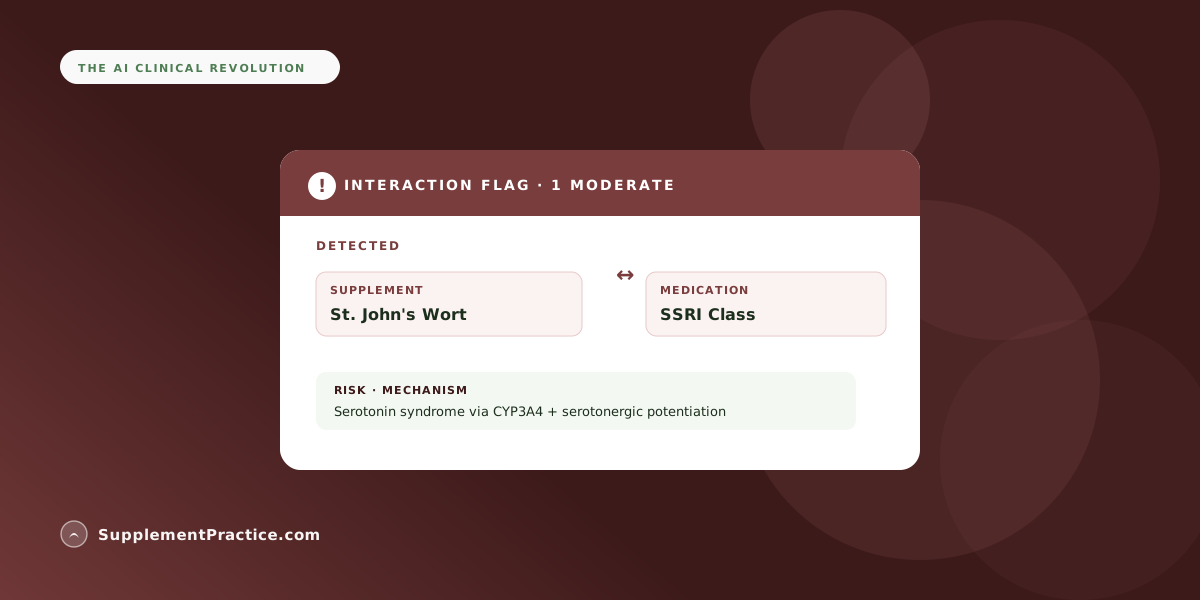
The highest-value uses are unglamorous. Interaction-checking is one: a tool that reads the full medication and supplement list and surfaces the concerning combinations is a safety net a busy clinician will miss on their own. Our piece on whether AI can help prevent supplement-drug interactions covers how that works in practice. Charting is the other: dictate the visit, let the model structure it, and reclaim the evenings — the mechanics are in our guide to reducing charting fatigue.
Notice the pattern. Every high-value use is a place where the clinician was already going to make the decision — the AI just removes the friction between the decision and the record of it.
What augmentation looks like on an ordinary Tuesday
It helps to picture the difference concretely. In the old workflow, a clinician sees a patient, scribbles notes, and then spends the evening reconstructing the visit into a chart, looking up two supplements against the patient's blood-pressure medication, and hand-building a dosing plan — three separate tasks, all after hours, all draining. In the augmented workflow the same visit produces a drafted note by the time the patient reaches the parking lot, an interaction check that already ran, and a schedule the patient walks out holding. The clinician's job shifts from producing all of that to reviewing and correcting it, which is faster and which is also the part that actually needs a trained mind.
That shift is why the replacement framing misleads. The tasks that got automated were never the valuable ones; they were the tax the clinician paid to get the valuable work recorded. Removing the tax does not remove the clinician. It removes the reason so many good practitioners burn out and the reason so many charts close late. Augmentation, done honestly, gives the license-holder more room to do the thing only a license-holder can do.
A naturopath in Vermont who stopped fearing the tool
Dr. Lena Okafor runs a solo naturopathic practice and spent a year quietly worried that AI intake tools would make her replaceable. She tried the opposite experiment: she let the software do everything it was good at. In Supplement Practice, intake summaries drafted themselves, protocol starting points appeared from the evidence, and interaction flags surfaced before she signed.
Six months later her panel had grown by a fifth and her charts closed the same day. Nothing about her judgment had been automated away — she edited nearly every draft. What vanished was the ninety minutes of typing that used to sit between her and her patients. Her conclusion was blunt: the tool did not replace her, it replaced her keyboard.
| Task | AI Handles | Clinician Owns |
|---|---|---|
| Intake summary | Drafts structured note from raw input | Verifies accuracy, adds clinical context |
| Supplement protocol | Proposes evidence-based starting point | Reviews, edits dose, signs |
| Interaction check | Flags concerning combinations | Judges clinical relevance, acts |
| Dosing schedule | Computes timing and printable plan | Confirms it fits the patient's life |
| Diagnosis and treatment | Nothing — proposes, never decides | Full responsibility |
Common mistakes practitioners make with AI
- Treating a draft as a decision. The model's output is a starting point to edit, not a protocol to hand a patient unread.
- Assuming it replaces the relationship. Patients adhere to people, not PDFs; automation that removes contact backfires.
- Skipping the review step. AI hallucinates confidently, so an unreviewed interaction flag or dose is a liability, not a shortcut.
- Waiting until it is perfect. The peer who adopts an imperfect tool now compounds a real time advantage over the one who waits.
- Ignoring scope and licensure limits. A model cannot expand what your license allows, and using it does not change your legal responsibilities.
The real competitive picture — and a word on the rules
The risk to your practice is not a robot. It is the practitioner down the road who uses AI to see more patients, close notes faster, and keep protocols tighter, while you do it all by hand. Adoption is the moat, not resistance.
There is also a patient-facing version of this. Patients increasingly arrive having already asked an AI engine about their symptoms and supplements, sometimes with good information and sometimes with confident nonsense. The practitioner's role in that world is not to compete with the model on recall — you will lose — but to do what it cannot: examine, contextualize, correct, and take responsibility. A clinician who understands the tool can even use a patient's AI curiosity as the opening for a better conversation rather than treating it as a threat.
One caution on the boundaries: scope-of-practice, licensure, and rules for AI-assisted documentation vary by state and by profession, and they change. Nothing here is legal advice. Before you lean on any AI tool for a clinical or billing decision, verify with your state board and licensing body, and check with a qualified attorney where liability is in play. Used inside those lines, AI is the best assistant a solo clinician has ever had — and still just an assistant.
Frequently asked questions
Can AI legally diagnose or treat patients on its own?
No. A model cannot hold a license, carry liability, or be disciplined by a board, so it cannot legally diagnose or treat. Regulators treat clinical AI as a tool a qualified human wields — the clinician remains fully responsible. See our overview of what AI can and cannot do.
Will AI-written supplement protocols get me in trouble?
Only if you skip the review step. An AI-drafted protocol is a first draft you edit and sign, exactly as you would a template. Used that way it is faster and safer; used unreviewed it is a liability. Our guide to building protocols in seconds shows the safe workflow.
Which practitioner tasks are safest to automate first?
Charting, intake summaries, interaction checks, and dosing schedules. These are lookup-and-compose tasks where the clinician already makes the decision — the AI just removes the typing. Diagnosis, hands-on care, and the treatment decision stay human.
Does using AI mean seeing patients less personally?
The opposite, when done right. AI removes the ninety minutes of daily paperwork that sits between you and the patient, freeing time for deeper visits. Automation that removes contact backfires because patients adhere to people, not documents.
Should I wait until AI tools are more mature?
Waiting is the real risk. The competitive threat is not AI replacing you — it is a peer who adopts an imperfect tool now and compounds a time advantage. Start with low-stakes tasks like charting and expand as you build trust in the output.
Where to go next
Read what AI can and cannot do for a wellness practice, how to build evidence-based protocols in seconds, and how to reduce charting fatigue.