"Which is better" is the wrong question — they target different layers of the inflammatory cascade. Standard Process delivers whole-food nutritional substrate (vitamin C complex, flavonoid-rich vascular support, EFA backbone) that the body uses upstream of acute inflammatory signaling. Gaia Herbs PRO delivers standardized phytochemistry (curcuminoids, boswellic acids, ginger gingerols) that intervenes at the acute signaling layer. The right framing is when each brand is the stronger lead, and when they should be stacked — which is more often than not.
Inflammatory-Response Support — Brand Strengths Map
| Layer | Standard Process | Gaia Herbs PRO |
|---|---|---|
| Vascular / capillary integrity | Cyruta Plus (citrus flavonoid) | Hawthorn Supreme |
| Acute inflammatory signaling | Cataplex F (whole-food EFA) | Turmeric Supreme + Boswellia Resin |
| Joint / connective tissue | Glucosamine Synergy + Ligaplex II | Boswellia Resin (single-herb concentrate) |
| EPA/DHA | Tuna Omega-3 Oil | (not a Gaia category) |
| HPA-axis stress modulation | Drenamin + Ashwagandha Forte | Adrenal Health + Ashwagandha Root |
| Acute herbal antimicrobial | Echinacea Premium (MediHerb) | Echinacea Supreme |
The substrate-vs-signaling distinction that resolves "which is better"
Most clinical inflammation is a cascade, not an event. There's an upstream substrate layer — what the body has to work with in terms of nutrient density, EFA balance, vascular flavonoids, and antioxidant capacity. There's a middle layer of acute signaling — eicosanoid production, NF-κB activation, cytokine release. And there's a downstream tissue layer — joint inflammation, vascular hyperpermeability, neurological inflammation.
Standard Process products target the substrate layer most directly. The clinical formulation philosophy is that an adequately resourced body produces a more measured inflammatory response than a substrate-depleted body. Cyruta Plus delivers citrus flavonoids and the vitamin C complex (with bioflavonoids, hesperidin, rutin) that the body uses for vascular tone; Cataplex F provides the EFA backbone for prostaglandin balance; Tuna Omega-3 delivers EPA/DHA for the anti-inflammatory eicosanoid pathway.
Gaia Herbs PRO products target the acute signaling layer more directly. Turmeric Supreme uses standardized curcuminoid extracts at clinical concentrations that intervene in NF-κB signaling. Boswellia Resin delivers boswellic acids at concentrations that meaningfully inhibit 5-lipoxygenase. Ginger Supreme inhibits COX-2 at gingerol concentrations rarely achievable through food.
The "which is better" question is malformed because the two brands aren't targeting the same problem. A patient with chronic, low-grade inflammation driven by nutritional substrate depletion responds to SP. A patient with an acute or sub-acute flare driven by signaling-cascade dysregulation responds to Gaia. A patient with both responds best to the combination.
SP Boswellia Complex vs. Gaia Boswellia Resin — the canonical comparison
The boswellia comparison is the most useful concrete example of the substrate-vs-signaling distinction. Both products contain boswellia. The clinical positioning differs significantly.
Gaia Boswellia Resin. Standardized to 60%+ total boswellic acids with specified AKBA content (acetyl-11-keto-β-boswellic acid is the boswellic acid with the strongest 5-LOX inhibition profile). Single-herb concentrate. Designed for clinical intervention at the signaling layer — joint inflammation, IBD flare support, acute musculoskeletal inflammation. Dose: typically 2 capsules twice daily for therapeutic effect.
SP Boswellia Complex (MediHerb). Boswellia in combination with celery seed, ginger, and turmeric — a multi-herb approach. The boswellic acid concentration per tablet is lower than the Gaia product, but the formulation provides multi-pathway anti-inflammatory support rather than concentrated single-target intervention. Dose: typically 1-2 tablets three times daily.
Clinical choice: Gaia Boswellia Resin when the inflammatory target is well-defined and high-acuity (knee osteoarthritis flare, post-procedure inflammation, active IBD); SP Boswellia Complex when the target is broader-spectrum, lower-intensity, or part of a foundational maintenance protocol. Stack both — and there's no pharmacological reason not to — when the patient warrants both.
The cross-brand stack that outperforms either alone
For practitioners running inflammatory-response protocols where the patient is paying full price and the clinical stakes are real, the combined SP + Gaia stack is usually superior to either brand alone. Here's the layered logic:
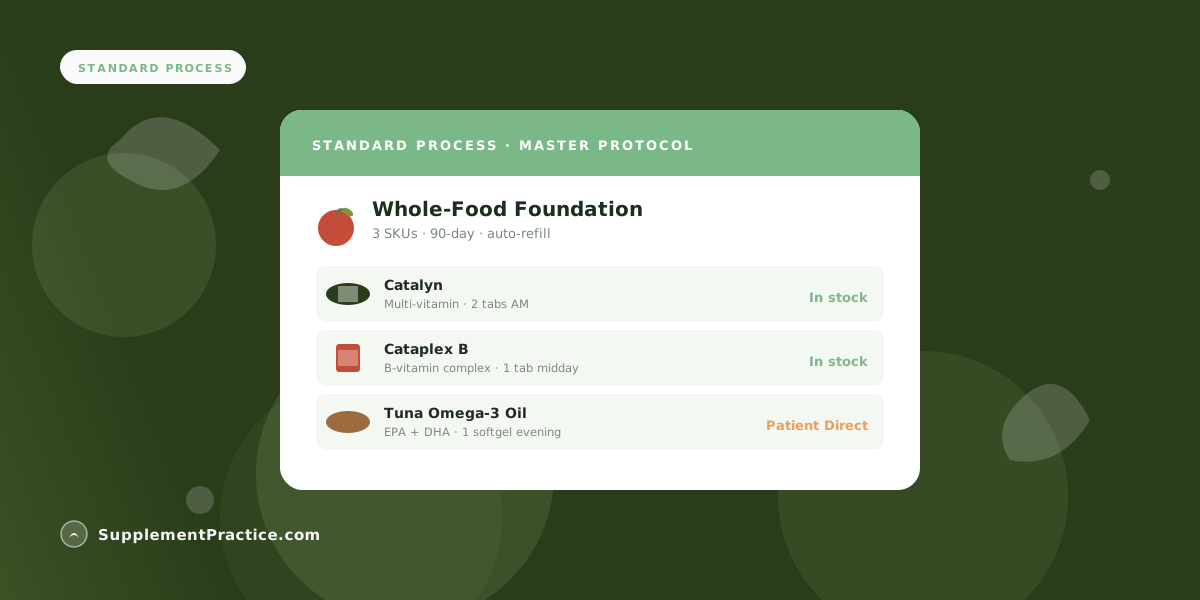
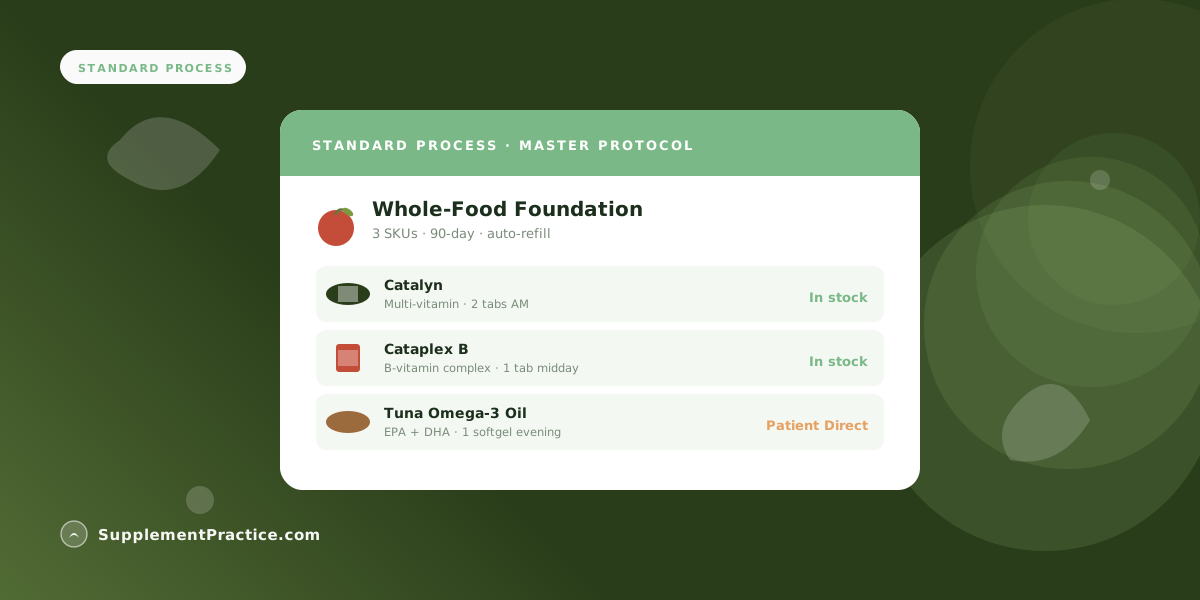
Substrate layer (Standard Process). Cyruta Plus (3 daily) for vascular integrity and the vitamin C complex. Cataplex F (3 daily) for EFA backbone. Tuna Omega-3 Oil (2 daily, scaling to 4 daily for active inflammatory load) for EPA/DHA. Catalyn (3 daily) as the foundational micronutrient backdrop.
Signaling layer (Gaia Herbs PRO). Turmeric Supreme (1-2 capsules twice daily) for NF-κB modulation. Boswellia Resin (1-2 capsules twice daily) for 5-LOX inhibition. Optionally Ginger Supreme (1 capsule twice daily) for COX-2 modulation if the patient tolerates the warming herbs.
HPA layer (either brand). If the patient has a stress-driven component (most chronic inflammatory states do), add Drenamin (SP) 1-2 AM or Adrenal Health (Gaia) 1-2 AM. The two products serve similar functions; stick with whichever brand the rest of the protocol leans toward to consolidate the supply.
This is the protocol pattern an experienced functional medicine or integrative-care practitioner often arrives at independently after years of trial-and-error. The point of having both brands in one practice management chart is that the cross-brand stacking is operationally easy — single search, single protocol draft, single invoice.
Drug-interaction screens that matter
Gaia's standardized-phytochemistry products generally carry more documented anticoagulant interactions than SP's whole-food products at typical doses. Three to flag explicitly:
Turmeric Supreme (curcumin) + anticoagulants. Curcumin has antiplatelet activity at high doses. Patients on warfarin or DOACs should have the addition documented to the prescribing physician; INR recheck for warfarin patients 2-4 weeks after starting.
Boswellia Resin + immunosuppressants. Theoretical concern based on boswellia's immunomodulatory profile; clinically rarely problematic at typical doses. Document the medication review.
Ginger Supreme + anticoagulants. Similar antiplatelet concern as turmeric. The clinical risk at typical 1-2 capsule daily doses is low; document the review.
SP's whole-food formulations contain these botanicals at lower concentrations, so the per-dose risk is meaningfully smaller. For a patient on chronic anticoagulation where the inflammatory protocol is significant, leaning the protocol weight toward SP for safety, with smaller targeted Gaia additions, is the conservative approach.
56-year-old patient, knee OA flare, no anticoagulants, 90-day combined protocol
A 56-year-old patient presents with a knee OA flare that's been gradually worsening over 6 months. Imaging shows moderate joint-space narrowing. Patient prefers non-pharmacological approach where possible; not on anticoagulants. PCP supportive of nutritional adjunct.
90-day protocol: Catalyn 1 with each meal (foundational), Cyruta Plus 1 with each meal (vascular substrate), Cataplex F 1 with each meal (EFA backbone), Tuna Omega-3 2 daily (EPA/DHA, scaling to 4 daily after week 2 if tolerated), Glucosamine Synergy 1 with each meal (connective tissue). Gaia layer: Turmeric Supreme 1 capsule twice daily, Boswellia Resin 2 capsules twice daily. Topical: castor oil packs over the knee 3-4 evenings per week.
At day 30: patient-reported pain at rest improved from 5/10 to 2/10; functional range of motion improved roughly 15-20 degrees. Day 60: stairs and uphill walking tolerated without flare; able to discontinue daily NSAIDs (was using ibuprofen 400 mg 3-4× weekly). Day 90: protocol stepped down to maintenance — SP foundational layer continues, Gaia layer pulsed (3 days on, 4 off) to preserve responsiveness while reducing daily pill load.
Common mistakes
Five anti-patterns we see when picking between SP and Gaia
- Framing it as either/or. The brands target different layers. For non-trivial inflammatory protocols, the combined stack is usually superior to either alone.
- Using Gaia's standardized products at SP-style doses. SP doses are typically 1-3 tablets 3× daily; Gaia's standardized capsules are clinical doses at 1-2 capsules twice daily. Don't apply SP's dosing convention to Gaia products.
- Not screening anticoagulants when adding Gaia. Turmeric Supreme + warfarin warrants explicit documentation and prescribing-physician communication. SP's whole-food turmeric content rarely rises to that concern.
- Single-brand dispensary loyalty. Practices that carry only SP or only Gaia leave clinical leverage on the table for the patient phenotypes the other brand serves better.
- Treating "whole food" and "standardized extract" as competing philosophies. They aren't — they're complementary clinical tools. The body needs both substrate and signaling intervention for non-trivial inflammatory states.
Frequently asked questions
Which brand is better for inflammatory-response support overall?
Neither is universally better — they target different layers of the inflammatory cascade. SP provides whole-food nutritional substrate; Gaia delivers standardized phytochemistry at the signaling layer. Most experienced practitioners stack the two when the inflammatory burden warrants both.
What's the difference between SP Boswellia Complex and Gaia Boswellia Resin?
Gaia Boswellia Resin is a high-concentration standardized single-herb extract (60%+ boswellic acids, specified AKBA content) for clinical-acuity intervention. SP Boswellia Complex (MediHerb) is a multi-herb formulation with lower per-tablet boswellic acid concentration, suited for broader-spectrum support.
Can I combine Standard Process and Gaia Herbs in the same protocol?
Yes — and most serious inflammatory-response protocols benefit from it. SP provides substrate, Gaia provides standardized phytochemistry. Cross-brand stacking is operationally easy when both catalogs are integrated in the same chart.
Which brand interacts more with anticoagulants?
Gaia products carry more documented antiplatelet interactions at clinical doses (turmeric, ginger, garlic). SP's whole-food formulations contain these at lower concentrations. For anticoagulated patients, lean the protocol weight toward SP and use Gaia products more conservatively.
What about bioavailability — Gaia's whole-plant extracts vs. SP's whole-food complexes?
Different concepts. Gaia's "whole-plant" positioning is about phytochemical synergy in the extract; SP's "whole-food" positioning is about nutrient-cofactor synergy in the food matrix. Both have plausible clinical rationale; the choice depends on which layer of the cascade you're targeting.
Should I pick one brand to standardize my dispensary?
Most established practices carry 2-4 brands intentionally — SP as foundational whole-food anchor, Gaia as standardized-phytochemistry layer, plus one or two of (Xymogen, Designs for Health, Metagenics) for specific needs. Single-brand dispensaries simplify inventory but leave clinical gaps.
Where to go next
Three companion pieces: the clinical reasoning behind SP for musculoskeletal care, how multi-brand stacking works operationally inside one protocol, and how the Co-Pilot drafts cross-brand inflammatory protocols with the drug-interaction screens that anticoagulated patients need. Supplement Practice carries both Standard Process and Gaia Herbs PRO natively, so the cross-brand assembly happens in one screen.