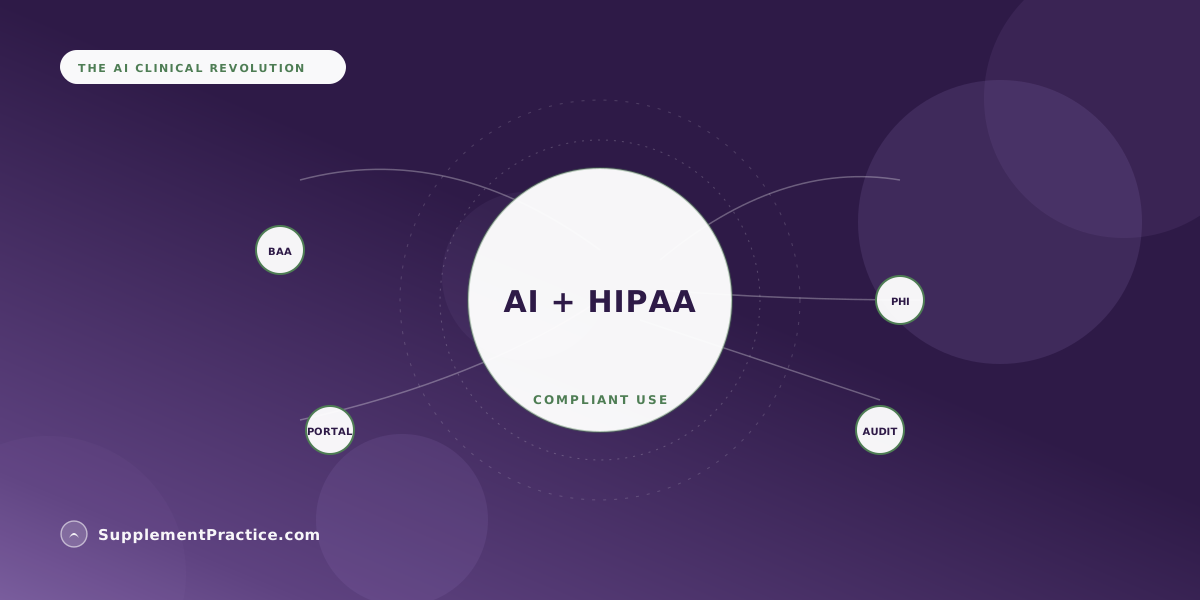
You can use AI without violating HIPAA by making sure any AI that touches protected health information is covered by a signed business associate agreement, keeping PHI inside that protected boundary, minimizing the data you expose, controlling who can access it, and maintaining an audit trail. The simplest rule: keep patient-identifiable information out of consumer AI tools, and run clinical AI inside a platform contracted and built to protect it.
The Compliant-AI Checklist
- Get a signed BAA with any AI vendor that will handle PHI
- Keep PHI inside the compliant boundary — never paste it into consumer chatbots
- Minimize data: expose only what the AI task genuinely needs
- Control access with roles, strong authentication, and least privilege
- Keep an audit trail of who accessed what and when
- You remain accountable — review AI output; it does not transfer responsibility
- Verify vendor settings, data retention, and training-use policies
HIPAA does not ban AI — it governs what touches PHI
The reassuring reality is that HIPAA was never written to forbid AI. It governs how protected health information is used and disclosed, full stop. AI is just another tool that either touches PHI or does not. Once you frame it that way, compliant AI stops being mysterious and becomes a short list of the same disciplines you already apply to any system handling patient data: a signed agreement, a protected boundary, least-necessary data, controlled access, and a record of what happened. Get those right and AI is not a liability — it is an asset you can defend.
Here is the practical playbook, in the order that matters.
Before the rules, one reframing that makes the whole topic easier: compliance is not a feature you buy, it is a posture you maintain. No vendor can hand you a compliant practice, because compliance depends on how you configure and use their tool as much as on the tool itself. The good news is that the posture is learnable and stable — the pillars below have not fundamentally changed even as the technology has, which means the effort you put into getting them right pays off across every new AI tool you adopt, not just today's.
Rule one: a BAA for anything that touches PHI
The single most important rule is that any AI vendor whose product processes protected health information must sign a business associate agreement with you. The BAA is what legally binds that vendor to protect the data. This is exactly why the standard consumer version of a public chatbot is off-limits for real patient work — there is no BAA behind it. If a tool cannot or will not sign one, it does not get PHI. That rule has no exceptions worth making — not for a quick question, not because the tool is popular, not because you are in a hurry. For the deeper treatment of that specific trap, see whether it is ever safe to use ChatGPT for patient notes and supplement protocols.
Getting a BAA in place is also less painful than practitioners fear. Reputable clinical-software vendors expect the request and have a standard agreement ready; you are not negotiating a bespoke contract from scratch. If a vendor treats a BAA request as unusual or cannot produce one promptly, that itself tells you something about whether they are built for healthcare.
Rule two: keep PHI inside the boundary
Even with a BAA, you want PHI to stay inside as few places as possible. The cleanest architecture is AI built into your practice platform, working on data that never leaves the compliant environment — encrypted at rest and in transit, isolated from the public internet, and grounded in your actual record rather than an outside model's open training data. That is the whole design premise of HIPAA-compliant software: the patient portal, the chart, the protocol drafting, and the AI all live behind one protected wall, so you are not shuttling PHI between vendors.
Rule three: minimize the data you expose
HIPAA's minimum-necessary principle applies squarely to AI. Give the AI task only the data it genuinely needs to do the job, not the entire chart out of convenience. Where a task can be done on de-identified data, de-identify it. This is both a compliance stance and a good engineering habit — smaller data surfaces mean smaller risk. When AI drafts protocols or plans, it should pull the specific, relevant intake, not dump the patient's whole history into a prompt, which is part of why grounded in-platform tools that build protocols in seconds are safer than a free-text chatbot.
Rule four: access control and an audit trail
Who can see PHI, and can you prove who saw it? Compliant AI use rides on the same access controls as the rest of your practice: role-based permissions, strong authentication, least privilege, and automatic logging. The HIPAA Security Rule effectively expects you to be able to reconstruct who accessed what and when. A platform that logs AI actions against a patient record the same way it logs a chart view gives you that audit trail without extra work. This discipline also supports the practice broadly, the same way integrated records improve patient adherence when everything lives on one record.
Rule five: you are still accountable
No agreement or setting transfers clinical responsibility to the AI. You review its output, you make the decisions, and you sign the note. A BAA protects the data; it does not vouch for the accuracy of a drafted protocol. Keep a human — you — in the loop for every clinically meaningful output, and verify each vendor's data-retention and training-use policies so you actually know whether your inputs could be reused. Compliant AI is a partnership between good tooling and your continued judgment.
The training-use question deserves special attention because it is where reasonable-looking tools quietly diverge. Two AI products can both offer a BAA, yet handle your inputs very differently — one contractually promising never to train its models on your data, another reserving broad rights to reuse it. From a HIPAA standpoint, and from a plain trust standpoint, that difference is enormous. Read the data-processing terms, not just the marketing page, and prefer vendors who state clearly that customer PHI is never used to train shared models. If you cannot find that commitment in writing, treat its absence as an answer.
A naturopathic clinic in Oregon builds an AI policy it can defend
Elena's three-provider clinic wanted the speed of AI for charting and protocol drafting but kept hearing horror stories about HIPAA. Instead of banning AI or using it recklessly, the clinic wrote a one-page policy: no PHI in any consumer tool, all clinical AI runs inside their platform under a signed BAA, each provider has role-based access, and every AI action is logged against the patient record.
They run that AI inside Supplement Practice, where protocol drafting and charting happen on the real record behind the compliance boundary, and the audit log captures who did what. When their attorney reviewed the setup, the answer was short: a signed BAA, minimum-necessary data, access controls, and an audit trail — the same pillars HIPAA has always asked for, now applied to AI. The clinic got the speed without the exposure.
| HIPAA safeguard | What it means for AI | How to satisfy it |
|---|---|---|
| Business associate agreement | Vendor is legally bound to protect PHI | Sign a BAA before any PHI is shared |
| Minimum necessary | Expose only the data the task needs | Scope inputs; de-identify where possible |
| Access controls | Right people, right data, provable | Roles, strong auth, least privilege |
| Audit controls | Reconstruct who accessed what | Automatic logging of AI actions |
| Human accountability | Clinician owns the output | Review and sign every clinical result |
Common HIPAA-and-AI mistakes
- Using a consumer chatbot with no BAA for real patient work. This is the most common and most avoidable violation.
- Dumping the whole chart into a prompt. Minimum necessary applies — give the task only what it needs.
- Skipping the vendor's retention and training-use policy. If your inputs can be reused to train a model, you need to know before you share PHI.
- Assuming a BAA makes the output correct. It protects data, not accuracy — you still review and sign.
- No audit trail. If you cannot show who accessed what, you cannot demonstrate compliance when it counts.
A note on verifying your own compliance
This is general guidance, not legal advice. HIPAA requirements, de-identification standards, vendor agreements, and state privacy laws change and can turn on specifics of your practice. Confirm your AI policy with a qualified attorney or privacy professional, and verify each vendor's BAA, settings, retention, and training-use policies directly. The durable takeaway is simple: AI is compliant when PHI stays inside a contracted, controlled, audited boundary and you remain the accountable clinician. Build on those pillars and you can adopt AI confidently.
Frequently asked questions
Is any AI automatically HIPAA-compliant?
No — HIPAA compliance is about how a tool is configured, contracted, and used, not a badge a product carries. An AI becomes part of a compliant workflow when it is covered by a signed BAA, keeps PHI inside a protected boundary, enforces access controls, and logs activity. The same underlying model can be compliant in one setup and not in another.
Do I need a BAA with an AI vendor?
If the AI will handle protected health information, yes — a business associate agreement is required. If the AI only ever touches genuinely de-identified or non-patient data, a BAA may not be necessary for that use. When in doubt, treat identifiable patient data as PHI and require the BAA. See what counts as HIPAA-compliant software.
Can I use AI scribes or note-takers in a wellness practice?
Yes, provided the scribe vendor signs a BAA, keeps the audio and notes inside a protected boundary, and you control access and retain an audit trail. Confirm the vendor's data-retention and training-use policies before recording any patient encounter. The clinical accuracy of the note remains your responsibility to review.
What is the minimum-necessary rule and how does it apply to AI?
Minimum necessary means you use or disclose only the PHI actually needed for a task. For AI, that means scoping the inputs — give the model the relevant intake for a protocol, not the entire chart, and de-identify where the task allows. Smaller data surfaces mean lower risk and cleaner compliance.
If I use compliant AI, am I still responsible for errors?
Yes. A BAA and a secure boundary protect the data; they do not make the AI's clinical output correct. You review every clinically meaningful result, make the decisions, and sign off. Compliant AI reduces your data risk and your workload, but the professional accountability stays with you.
Where to go next
Read whether it is safe to use ChatGPT for patient notes, learn what counts as HIPAA-compliant software, and see what AI can and cannot do in a wellness practice.