Five concrete safeguards ensure clinical accuracy when AI is drafting supplement protocols: catalog grounding (so it can't recommend SKUs that don't exist), override-rate monitoring (40-60% is the healthy range), citation auditability (spot-check sources), drug-interaction screen verification (test deliberately), and the per-protocol practitioner-review checklist (six questions, 2-3 minutes). Together these eliminate the failure modes that make AI clinical use risky and preserve the practitioner's accuracy responsibility.
Five Safeguards for AI Clinical Accuracy
- Catalog grounding: AI grounds against practice's carried brands
- Override rate: target 40-60% steady-state
- Citation audit: spot-check 5-10 AI recommendations per week
- Interaction screen verification: test deliberately quarterly
- Per-protocol review checklist: 6 questions in 2-3 minutes
- Liability: unchanged — sits with the signing practitioner
Safeguard 1: catalog grounding
The single most important AI accuracy safeguard is structural: the AI must ground against a verified product catalog, not generate from open-ended text completion. A generic LLM asked "recommend a magnesium product at 200mg for a sensitive patient" will produce a plausible-sounding answer that may reference SKUs that don't exist at doses that don't exist, with confidence that sounds clinically valid. Catalog grounding eliminates this failure mode — the AI can only recommend products that are in the catalog at doses the catalog supports.
What to verify when evaluating an AI tool: ask the vendor specifically how the AI grounds. "Retrieval-augmented generation against a verified catalog database" is the right architecture. "Trained on supplement data" or "knows about supplements" is not — those phrasings suggest the AI generates from learned patterns rather than retrieving from verified data, which is the recipe for hallucination.
Safeguard 2: override-rate monitoring
The practitioner override rate is a leading indicator of whether the AI workflow is functioning correctly. Steady-state target: 40-60% of AI-drafted protocols receive at least one practitioner override before approval.
Below 25% means the practitioner is likely rubber-stamping. Either trust is too high, the patient population is unusually uniform, or the practitioner has lost the override habit. Audit recent protocols for missed clinical refinements.
40-60% is healthy. The AI is drafting reasonable starting points; the practitioner is applying clinical judgment to refine them. This is what good AI-assisted workflow looks like.
Above 70% means either the AI tool's quality is too low for the patient population, or the practitioner hasn't calibrated trust appropriately. Investigate which.
Track override rate as a weekly metric in the practice dashboard. Patterns over time matter more than single-week snapshots.
Safeguard 3: citation auditability
Every AI clinical recommendation should reference identifiable, durable sources. Brand monographs, NIH ODS fact sheets, Linus Pauling Institute entries, IFM module resources, named clinical textbooks. Generic "studies show" or "research suggests" without source citation is a red flag.
The audit pattern: spot-check 5-10 AI recommendations per week by actually clicking through the cited sources. Patterns of broken links, DOIs that don't resolve, PMIDs that route to unrelated papers, or brand monographs that don't exist indicate the AI tool is hallucinating citations. This is a hard quality-bar failure that disqualifies the tool from clinical use.
Safeguard 4: drug-interaction screen verification
The interaction screen is one of the highest-leverage features of AI clinical decision support — and one of the easiest to verify is working. Test deliberately, quarterly, against known interactions.
Compose protocols for hypothetical patients with:
- Warfarin + high-dose vitamin E (anticoagulation interaction) — should flag
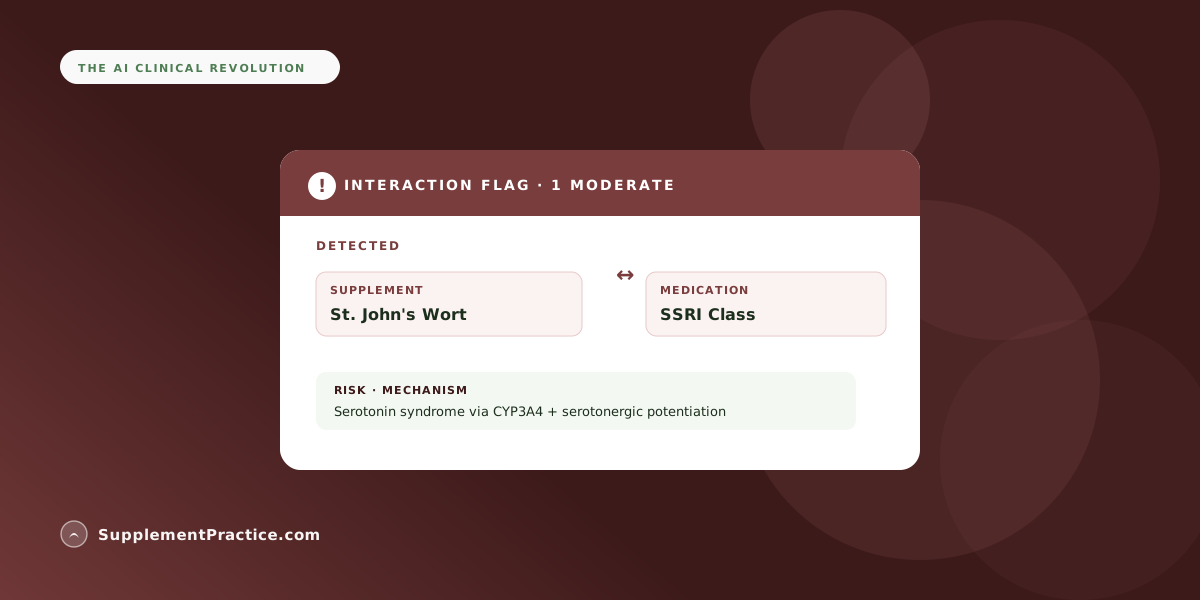
- St. John's Wort + SSRI (serotonergic risk) — should hard-block
- Calcium + levothyroxine (absorption window) — should surface 4-hour separation
- Iron + levothyroxine — should surface 4-hour separation
- CoQ10 + warfarin — should flag mild-moderate
If any of these standard interactions don't flag at expected severity, the screen isn't working properly. Either the database is incomplete, the medication reconciliation step is broken, or the tool's interaction-checking logic has gaps. Don't trust the screen until you've verified it personally.
Safeguard 5: the per-protocol practitioner-review checklist
Six questions, runnable in 2-3 minutes per protocol, catch the majority of AI-output issues before they reach the patient.
1. Are all SKUs in the practice's carried-brands list? Verifies catalog grounding worked correctly.
2. Do doses match what the patient can realistically tolerate? Patient-specific dosing history overrides default suggestions for sensitive patients, elderly patients, etc.
3. Are interactions flagged appropriately against current medications? Confirms the screen ran against current data.
4. Does the protocol address the patient's stated priority? Patients often have a different chief concern than the AI's clustering identified. The protocol should respect patient priorities even when the AI sees other patterns.
5. Is the schedule realistic for the patient's life? Pill burden, timing complexity, food-dependency constraints all affect real-world compliance.
6. Is the cost within the patient's stated range? A clinically optimal protocol the patient can't afford is the practical equivalent of no protocol.
Quarterly accuracy audit at a 3-practitioner clinic
A 3-practitioner FM clinic runs a quarterly AI accuracy audit. The protocol: spot-check 20 random protocols per practitioner from the prior quarter, evaluate each against the 6-question review checklist, plus verify a sample of 10 citations and 5 deliberate interaction tests.
Q2 audit findings: 92% of spot-checked protocols passed all 6 checklist items. The 8% failures were almost all on item 6 (cost) — the AI was recommending optimal but expensive protocols for patients with documented budget constraints. Practitioners had usually caught and adjusted before approval, but in 4 cases the cost wasn't adjusted and the patient returned to renegotiate. Citation audit found one hallucinated source (a referenced "Standard Process clinical trial" that didn't exist) — investigated, traced to a misconfigured retrieval source, vendor patched. Interaction screen tests all passed.
Action items: tighten the patient-budget intake field and feed it more weight in the protocol composition; vendor patch verified. Q3 audit showed 96% pass rate on the same checklist.
Common mistakes
Five anti-patterns in AI clinical accuracy management
- Assuming the AI tool works without verifying. Test deliberately at adoption and quarterly thereafter.
- Ignoring override-rate metrics. The leading indicator of workflow health.
- Not auditing citations. Hallucinated sources are a disqualifying failure.
- Skipping the practitioner-review checklist. The 2-3 minute review catches most issues.
- Treating AI output as binding rather than advisory. Practitioner judgment is the final authority.
Frequently asked questions
What's the single most important safeguard?
Catalog grounding. Eliminates the hallucinated-SKU failure mode that generic LLMs produce.
What override rate should a practitioner aim for?
40-60% in steady-state. Below 25% is under-override (rubber-stamping); above 70% is over-override (tool quality or trust calibration issue).
How do I audit the AI's citations?
Spot-check 5-10 recommendations per week by clicking through cited sources. Patterns of broken links or hallucinated sources are disqualifying.
How do I verify the drug-interaction screen?
Test deliberately quarterly with known interactions: warfarin + vitamin E, St. John's Wort + SSRI, calcium + levothyroxine, etc. If standard interactions don't flag, the screen isn't working.
What's the practitioner-review checklist?
Six questions in 2-3 minutes: SKU catalog membership, dose appropriateness, interaction flags, patient priority alignment, schedule realism, cost fit.
What's the liability posture?
Unchanged. Liability sits with signing practitioner — AI is decision-support, same legal status as a clinical reference. Audit trail strengthens defensibility.
Where to go next
Three companion pieces: interaction screening deep-dive, protocol composition workflow, and survey analysis quality framework. Supplement Practice's practitioner dashboard exposes override rates, citation audit logs, and protocol-checklist completion metrics.