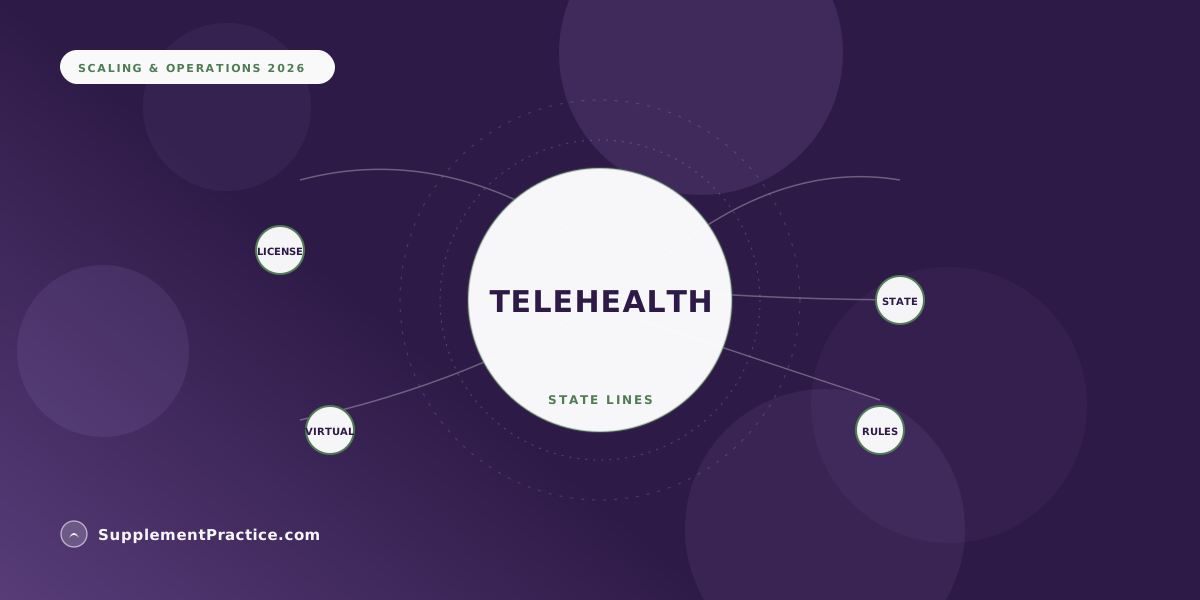
In most cases, a naturopath can only treat a patient by telehealth in a state where the naturopath holds a valid credential — because care is generally considered to occur where the patient is physically located, not where the provider sits. Naturopathic licensure varies sharply by state: some license naturopathic doctors, some register or certify them, and some do not regulate the title at all, so there is no single national rule. Always verify each state's requirements with that state's naturopathic board before seeing a patient there.
The Rule and Its Exceptions
- Care is generally located where the patient is sitting, so the patient's state law usually governs
- Naturopathic licensure differs sharply by state — licensed, registered, certified, or unregulated
- There is no nationwide naturopathic license or automatic reciprocity you can assume
- Being licensed in your home state does not authorize treating patients in another state
- Some states restrict how or whether unlicensed persons may use the naturopathic title
- HIPAA-compliant telehealth technology is necessary but not sufficient — licensure still governs
- Verify each state with its board before scheduling; rules change and are enforced individually
The governing question is not the technology — it is where the patient sits
Practitioners often ask about telehealth as if it were a software question. It is not. The technology is the easy part. The hard part is a licensure question: for most healthcare providers, care is considered to take place where the patient is physically located at the time of the visit. That means the patient's state — its board, its scope rules, its title-protection laws — generally governs whether you may treat that person, regardless of where you are sitting.
Apply that lens and the answer becomes clear: a naturopath can usually provide telehealth to a patient in another state only if the naturopath holds a valid credential in that state, or the state does not regulate the activity in question. Your home-state license does not travel with you across the border by default.
Why naturopathic licensure makes this especially tricky
For physicians, interstate telehealth is complicated but at least sits on a common framework of medical boards. Naturopathic regulation is far less uniform. Some states license naturopathic doctors with a defined scope. Others register or certify them with narrower authority. And a number of states do not regulate the naturopathic title at all — which does not automatically make cross-border practice safe, because it may raise questions about title use, scope, or the unlicensed practice of medicine.
The practical consequence is that there is no single national naturopathic license and no blanket reciprocity you can lean on. Each state is its own puzzle. A protocol that is squarely within your scope at home may exceed what a neighboring state permits, or may not be recognized there at all.
This unevenness also means you cannot reason by analogy from a physician colleague or a nutritionist friend. The way another profession or another state handles interstate telehealth tells you very little about how naturopathic practice is treated where your patient sits. The only reliable input is the specific rule for naturopaths in the specific state in question, at the current moment — which is why verification, not assumption, is the whole game here.
What you generally need before treating an out-of-state patient
Before you see a patient located in another state, work through a short checklist: confirm whether that state regulates naturopathic practice and at what level; determine whether your credential is recognized or whether you would need to obtain one there; check the permitted scope, especially anything involving labs, prescriptive authority, or the naturopathic title itself; and confirm the state's telehealth-specific rules, which sometimes require an established relationship or an initial modality. When any of those is unclear, the safe default is to not schedule until you have verified.
The delivery layer still matters too. Whichever states you serve, run visits on genuinely secure infrastructure — see HIPAA-compliant telehealth with integrated billing and the fundamentals in what actually counts as HIPAA-compliant software. Secure technology is necessary but never sufficient — it does not create licensure you do not have.
How compliant naturopaths structure a multi-state practice
Naturopaths who serve patients in more than one state usually do it deliberately: they hold credentials in each state where they have meaningful patient volume, they keep a clear record of where each patient is located at the time of each visit, and they configure their systems so scope and documentation match the governing state. Building a virtual practice is very achievable — the discipline is doing it state by state rather than assuming one license covers the map. If you are scaling a virtual model, how to scale a virtual practice walks through the operational side.
A useful way to plan is to treat each new state as a small business decision rather than a favor to one patient. Getting credentialed in a second state takes time and money, so it makes sense where you expect real volume — a cluster of patients, a referral source, a market you want to serve — and rarely makes sense to chase a single relocating patient. When one patient moves away, the honest options are usually to pause clinical care until you are credentialed there, or to refer them to a naturopath licensed in their new state, while you decide whether that state is worth entering deliberately.
The dispensary crosses state lines more easily than the visit
One bright spot: shipping recommended supplements to patients is generally more straightforward than the clinical visit, though sales-tax obligations follow the patient's location and vary by state. A virtual dispensary lets you fulfill protocols to patients wherever they are, even as the clinical encounter itself remains bound by licensure. Just keep the two questions separate — where you may treat, and where you may ship — because they are governed by different rules.
A naturopath in Arizona wants to keep a patient who moved to Texas
Dr. Priya S. built a thriving telehealth practice from Arizona, where she holds an active naturopathic license. A long-term patient relocated to Texas and asked to continue care by video. Before rebooking, Dr. Priya checked how Texas treats naturopathic practice rather than assuming her Arizona license carried over — and found the landscape genuinely different from her home state.
She used Supplement Practice to log each patient's current location at the time of every visit, so her records clearly reflected which state governed each encounter. For the Texas patient, she paused clinical visits until she had verified her standing, but continued shipping the patient's existing supplement protocol through the virtual dispensary while she sorted out the licensure question with a qualified attorney.
Where the patient is versus where you are
| Scenario | Governing state (general rule) | Typical requirement |
|---|---|---|
| You and patient both in your licensed state | Your home state | Your existing credential |
| Patient temporarily traveling out of state | The state the patient is currently in | Verify that state's rules first |
| Patient permanently in another state | The patient's state | Credential recognized or obtained there |
| Shipping supplements only, no visit | Product and tax rules of patient's state | Sales-tax compliance, not licensure |
This is general guidance — verify before you rely on it
Nothing here is legal advice, and none of it should be treated as a specific state's rule stated universally. Naturopathic scope, licensure, title protection, telehealth-specific requirements, and sales-tax treatment all vary by state and change over time. Before you treat a patient located in any state, verify the current requirements with that state's naturopathic board, and consult a qualified healthcare attorney for anything ambiguous. The cost of confirming is trivial next to the cost of practicing without authority.
Common mistakes with interstate telehealth
- Assuming your license travels. A home-state credential does not authorize treating a patient physically located in another state.
- Confusing secure tech with legal authority. HIPAA-compliant video makes a visit private, not permitted — licensure is a separate question.
- Treating “unregulated” as “anything goes.” A state that does not license naturopaths may still restrict title use or scope in ways that affect you.
- Not recording patient location. Without a clear log of where each patient sat during each visit, you cannot show which state governed the encounter.
- Conflating the visit and the shipment. Where you may treat and where you may ship supplements follow different rules — verify each separately.
Frequently asked questions
Can I treat a patient in another state if I am licensed in my own?
Generally no — care is usually considered to occur where the patient is physically located, so you typically need to be credentialed in the patient's state or practice within a state that does not regulate the activity. Your home-state license does not automatically extend across the border. Verify with the patient's state naturopathic board before scheduling.
Is there a national naturopathic license for telehealth?
No. Naturopathic licensure varies sharply by state — some license, some register or certify, and some do not regulate the title at all — and there is no nationwide license or automatic reciprocity. You must evaluate each state individually.
What if the patient is only traveling temporarily?
The general rule still points to where the patient is physically located at the time of the visit, so a patient traveling in another state may bring that state's rules into play. Confirm the specific state's requirements before the visit rather than assuming your usual license applies.
Does HIPAA-compliant telehealth solve the cross-state problem?
No. Secure, HIPAA-compliant telehealth is necessary for privacy but does not grant licensure. You still need the legal authority to treat a patient in their state, regardless of how secure the technology is.
Can I at least ship supplements to patients in other states?
Shipping recommended supplements is generally more straightforward than the clinical visit, though sales-tax obligations follow the patient's location and vary by state. A virtual dispensary can fulfill protocols across state lines even when the clinical encounter remains bound by licensure — keep the two questions separate and verify tax rules.
Where to go next
Continue with HIPAA-compliant telehealth with integrated billing, what actually counts as HIPAA-compliant software, and how to scale a virtual practice.