The best EHR for a functional medicine practice is one built around a longitudinal patient story rather than a billing encounter. Conventional electronic health records optimize for ICD-coded visits and fifteen-minute slots; root-cause medicine needs a timeline, flexible charting, functional lab interpretation, and a dispensary in the same record. This guide covers what to require and what to walk away from.
What a Functional Medicine EHR Has to Do
- Show a longitudinal timeline, not just a stack of dated encounters
- Support flexible, narrative charting — not rigid coded templates only
- Hold functional lab ranges alongside conventional reference ranges
- Link protocols and supplements directly into the chart
- Handle long intake and symptom-survey instruments natively
- Run HIPAA-eligible with a signed BAA
- Integrate scheduling, billing, and the dispensary in one record
Conventional EHRs are built for a different kind of medicine
Most electronic health records on the market were designed around a simple economic unit: the coded, billable encounter. Their data model assumes a patient arrives with a complaint, receives an ICD-10 code and a CPT code, and leaves — and the software is optimized to make that loop fast and reimbursable. Functional medicine does not fit that shape. A root-cause practice works across months, correlates lifestyle and labs and history, and treats the supplement protocol as a core intervention rather than an afterthought. Forcing that work into an encounter-coded EHR is why so many integrative clinicians describe their software as fighting them.
This isn't a knock on conventional EHRs — they're excellent at what they were built for. It's a warning against buying the wrong tool because it's the famous one. We've written at length about why legacy practice management software slows functional medicine clinics down; the EHR is the sharpest instance of that mismatch, because it's where the clinical thinking actually lives.
Requirement 1: A longitudinal timeline, not a pile of encounters
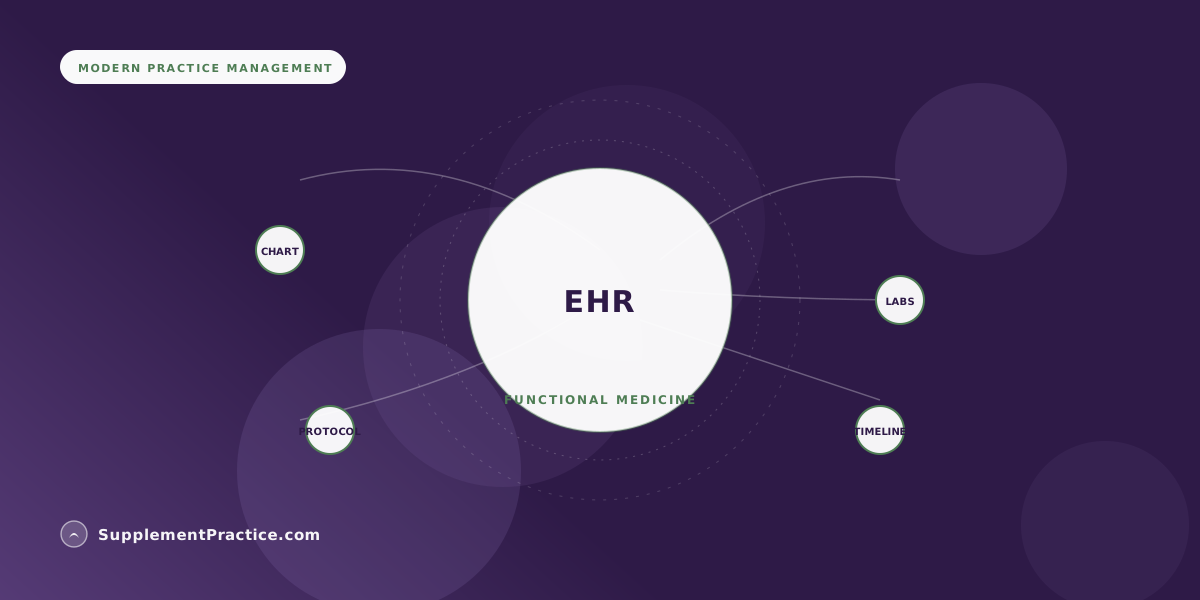
The single most important capability is a view of the patient over time. Functional medicine reasons about trajectories — a ferritin drifting down over three visits, a sleep score improving after a magnesium change, cortisol rhythm shifting across a protocol. An EHR that stores each visit as an isolated note forces the practitioner to reconstruct the arc by hand every time. A timeline-first record surfaces the trajectory automatically, which is both faster and clinically better, because patterns you'd miss in separate notes become obvious when they're plotted on one line.
Requirement 2: Charting that bends to your reasoning
Coded templates are efficient for repetitive, protocolized care and stifling for individualized medicine. A functional EHR needs to support genuinely flexible charting — narrative sections, matrix-style organizing frameworks, custom fields for the systems you actually assess — without abandoning structure entirely. The goal is charting that captures clinical reasoning at the speed of thought, which is exactly the problem we unpack in our guide to reducing charting fatigue in a busy functional medicine office. If the template fights the way you think, you will either fight it back every visit or quietly stop documenting the nuance that makes your care valuable.
Requirement 3: Functional and conventional lab ranges together
Conventional reference ranges answer "is this pathological?" Functional ranges answer "is this optimal?" — and a root-cause practice reasons in both. A free T3 of 2.4 pg/mL is inside the lab's normal range and outside most functional targets, and that gap is often the whole clinical conversation. An EHR that can display both ranges, trend markers over time, and let you annotate against a functional target is doing real work; one that only shows the lab's own flags is making you keep a second mental model. This is also where lab data should feed protocol decisions directly rather than being re-keyed.
A functional medicine practice migrating off a conventional EHR
A three-provider functional medicine clinic had run a mainstream EHR for four years. Clinically it worked against them daily: labs lived in scanned PDFs, protocols were typed into free-text notes and re-entered into a separate storefront, and there was no way to see a patient's cortisol or ferritin trajectory without opening five encounters side by side. New-patient reviews took the better part of an hour just to reconstruct the story.
Moving to a record built around a timeline changed the unit of work. Labs now trend on one view with functional ranges annotated; protocols build from the integrated dispensary and land in the chart automatically; the supplement recommendation, the invoice, and the reorder are one object. The clinical director's summary: the software finally organizes information the way the practice reasons, and new-patient prep dropped from about an hour to roughly twenty minutes.
Requirement 4: The dispensary lives in the record
For a practice where supplements are a primary intervention, keeping the protocol in a separate storefront from the chart is the same reconciliation problem that plagues every disconnected stack — doubled, because it also touches clinical safety. When the dispensary is part of the EHR, a protocol change updates the chart, the schedule, and the reorder together, and a medication-interaction screen can run against the same record that holds the prescriptions. Practices that have lived on both sides describe this as the difference between the software supporting the clinical model and merely tolerating it; it's a core reason integrative clinicians are moving to platforms built for supplement-centered care.
Requirement 5: It handles the intake instruments you actually use
Functional medicine runs on long, structured intake — symptom-burden questionnaires, timeline histories, diet and lifestyle inventories. A conventional EHR often can't ingest these natively, so they end up as attached PDFs the practitioner reads and manually summarizes. A fitting EHR captures structured intake as data the record can use — to pre-populate the timeline, to surface patterns, and increasingly to feed protocol suggestions, as we describe in using automated health surveys to pre-screen patients for supplement needs.
EHR fit scorecard for a root-cause practice
| Capability | Conventional EHR | Functional-fit EHR |
|---|---|---|
| Patient view | Stack of coded encounters | Longitudinal timeline |
| Charting | Rigid coded templates | Flexible + structured |
| Lab ranges | Conventional only | Functional + conventional |
| Intake instruments | Attached PDFs | Structured data |
| Dispensary | External storefront | In the record |
| Optimized for | Billable encounters | Root-cause trajectories |
Common mistakes when choosing a functional medicine EHR
Five decisions that come back to bite
- Buying the famous EHR because it's famous. Market share is built on coded-encounter medicine. Fit for root-cause work is a different axis entirely.
- Accepting labs as scanned PDFs. If lab values aren't structured data, you can't trend them, and trending is the whole point.
- Keeping the dispensary outside the chart. It splits clinical safety and revenue across two systems and guarantees drift.
- Underweighting migration. Ask exactly how existing charts, labs, and protocols come across before you commit — a bad migration can erase years of history.
- Ignoring charting speed. An EHR you dread documenting in produces thinner records over time, which quietly degrades your care.
The record is where the practice thinks
An EHR isn't neutral infrastructure — its data model shapes how you reason about patients. A record organized around billable encounters nudges you toward encounter-shaped thinking; a record organized around a longitudinal story supports the trajectory-based reasoning functional medicine depends on. For a supplement-centered practice, the additional requirement is that the dispensary and the interaction screen live in that same record, so clinical care and revenue and safety aren't spread across systems that disagree. Choose the EHR whose shape matches how your practice actually works, and the software stops being something you fight and starts being something you think with.
Frequently asked questions
Why don't conventional EHRs work well for functional medicine?
Most were designed around the coded, billable encounter — patient arrives, gets ICD and CPT codes, leaves. Functional medicine reasons across months, correlates labs and lifestyle over time, and treats supplement protocols as a core intervention. That work doesn't fit an encounter-coded data model, which is why integrative clinicians so often describe their EHR as fighting them.
What is the single most important EHR feature for a root-cause practice?
A longitudinal timeline. Functional medicine reasons about trajectories — a marker drifting over several visits, a symptom score improving after a protocol change — and an EHR that stores each visit as an isolated note forces you to reconstruct that arc by hand every time. A timeline-first record surfaces the pattern automatically.
Should the supplement dispensary be inside the EHR?
For a supplement-centered practice, yes. When the dispensary lives in the record, a protocol change updates the chart, schedule, and reorder together, and a medication-interaction screen can run against the same chart that holds the prescriptions. Keeping it in an external storefront splits clinical safety and revenue across two systems that will eventually disagree.
Can a functional medicine EHR handle functional lab ranges?
A fitting one can. It should display functional optimal ranges alongside conventional reference ranges, trend markers over time, and let you annotate values against a functional target. An EHR that only shows the lab's own pathological flags forces you to keep a second mental model for optimal ranges.
How important is data migration when switching EHRs?
Critical, and frequently underestimated. Before committing, get specifics on how existing charts, structured lab values, and protocols transfer. A poor migration can leave years of patient history trapped in PDFs or lost entirely, which undermines the longitudinal view that makes a functional EHR worth having.
Where to go next
For the pieces that surround the EHR decision, read why legacy software slows functional medicine clinics, how to reduce charting fatigue, and why integrative doctors are switching to supplement-centered platforms.